Unified Inbox vs Traditional Customer Service Tools: Which One Does Modern Business Need?

Introduction

Customer communication has changed dramatically over the past decade.

Customers no longer rely on a single communication channel to interact with businesses. Instead, they move seamlessly between WhatsApp, Instagram, Facebook Messenger, email, websites, and phone calls—often within the same customer journey.

However, many businesses continue to manage these channels separately using traditional customer service tools.

Support agents switch between multiple applications.

Sales teams use personal WhatsApp accounts.

Marketing communicates through email.

Customer information becomes scattered, conversations are disconnected, and response times slow down.

This fragmented approach creates operational inefficiencies and negatively impacts the customer experience.

This is why businesses are increasingly replacing traditional customer service tools with a Unified Inbox.

In this article, we’ll compare Unified Inbox platforms with traditional customer service systems and explain why modern businesses are making the shift.


What Is a Traditional Customer Service Tool?

Traditional customer service tools were designed for a time when customer communication happened through only a few channels.

These systems typically manage:

  • Email tickets
  • Phone calls
  • Basic live chat
  • Support tickets

While they remain useful for handling customer requests, they often treat each communication channel as a separate workflow.

As customer communication expands, these tools become increasingly difficult to manage.


What Is a Unified Inbox?

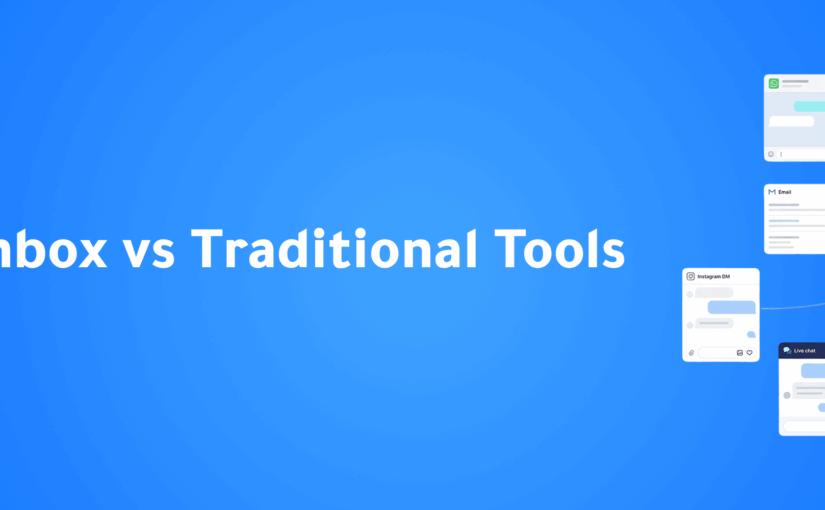
A Unified Inbox centralizes customer conversations from multiple communication channels into one workspace.

Instead of switching between several applications, customer-facing teams can manage every interaction from a single interface.

A Unified Inbox can combine conversations from:

  • WhatsApp
  • Instagram
  • Facebook Messenger
  • Website Live Chat
  • Email
  • SMS
  • Mobile Applications

Every customer interaction becomes part of one connected conversation.


Why Traditional Customer Service Tools Are Becoming Outdated

Customer expectations have changed.

Businesses now need to respond faster, personalize communication, and maintain context across multiple channels.

Traditional systems struggle because they were not designed for omnichannel customer engagement.

Common limitations include:

  • Disconnected conversations
  • Slow response times
  • Manual customer tracking
  • Duplicate customer records
  • Limited collaboration
  • Minimal automation

As communication channels multiply, these problems become more significant.


Unified Inbox vs Traditional Customer Service Tools

Feature Traditional Customer Service Tools Unified Inbox
Communication Channels Limited Multiple channels in one place
Customer History Often fragmented Complete customer timeline
Team Collaboration Limited Shared conversations and ownership
CRM Integration Basic or separate Deep CRM integration
AI Support Limited AI-powered assistance
Workflow Automation Minimal Advanced automation
Customer Experience Inconsistent Seamless across channels
Scalability Limited Designed for growing businesses

The comparison highlights a clear trend.

Modern customer engagement requires more than traditional support software can offer.


Benefit #1: One Customer, One Conversation

Customers rarely stay on one communication channel.

A customer may:

  • Discover your business on Instagram
  • Ask questions on WhatsApp
  • Continue through email
  • Call customer support
  • Return through website chat

Traditional tools treat these as separate conversations.

A Unified Inbox connects them into one complete customer journey.

Employees immediately understand the full context of every interaction.


Benefit #2: Faster Response Times

Switching between multiple applications wastes valuable time.

Support teams often lose productivity searching for conversations.

With a Unified Inbox:

  • All conversations appear in one dashboard.
  • Teams can prioritize urgent inquiries.
  • AI can route conversations automatically.
  • Responses become significantly faster.

Faster response times improve customer satisfaction and increase sales opportunities.


Benefit #3: Better Team Collaboration

Customer communication is no longer handled by one department alone.

Sales, customer support, marketing, and account management all contribute to the customer experience.

A Unified Inbox allows teams to:

  • Share conversations
  • Assign ownership
  • Leave internal notes
  • Track customer progress
  • Avoid duplicate responses

Collaboration becomes much more efficient.


Benefit #4: Complete Customer Visibility

A Unified Inbox connects communication with customer data.

Instead of viewing isolated messages, employees can access:

  • Contact information
  • Conversation history
  • Purchase records
  • Open opportunities
  • Support requests
  • Previous interactions

This enables more personalized communication.

Customers never need to repeat the same information.


Benefit #5: AI Makes Customer Service Smarter

Modern Unified Inbox platforms integrate Artificial Intelligence directly into customer communication.

AI can:

  • Respond instantly
  • Qualify leads
  • Detect customer intent
  • Analyze sentiment
  • Recommend replies
  • Prioritize conversations
  • Generate summaries

Instead of replacing employees, AI improves productivity while enhancing customer experiences.


Benefit #6: Workflow Automation

Traditional customer service often relies on manual processes.

Employees create tasks manually.

Managers assign conversations manually.

Follow-ups depend on reminders.

Unified Inbox platforms automate these activities.

Examples include:

  • Automatic lead assignment
  • CRM updates
  • Task creation
  • Customer journey automation
  • Follow-up reminders

Automation reduces administrative work while improving consistency.


Benefit #7: Better Analytics and Reporting

Traditional support systems often provide limited reporting.

A Unified Inbox offers deeper insights, including:

  • First response time
  • Resolution time
  • Customer satisfaction
  • Conversation volume
  • Agent performance
  • Channel performance
  • Customer engagement trends

These insights help businesses improve both customer service and operational efficiency.


Which Businesses Benefit Most from a Unified Inbox?

A Unified Inbox is particularly valuable for organizations that:

  • Receive inquiries across multiple communication channels
  • Have growing sales or support teams
  • Manage high conversation volumes
  • Want faster response times
  • Need better collaboration
  • Plan to implement AI-powered customer engagement

As businesses scale, managing conversations from one platform becomes increasingly important.


How ConnectGain Helps Businesses Modernize Customer Communication

ConnectGain replaces disconnected customer service tools with one intelligent customer engagement platform.

With ConnectGain, businesses can:

  • Manage WhatsApp, Instagram, Messenger, website chat, email, and other channels from a Unified Inbox
  • Centralize customer information through an integrated CRM
  • Automate customer journeys and repetitive workflows
  • Deploy AI-powered customer assistants
  • Qualify leads automatically
  • Analyze customer conversations using AI
  • Monitor performance through real-time dashboards

By combining AI, CRM, workflow automation, and omnichannel communication, ConnectGain helps businesses deliver faster, more personalized, and more scalable customer experiences.


The Future of Customer Communication

The future of customer service is no longer about managing individual communication channels.

It is about creating one connected customer experience.

Businesses are moving toward intelligent platforms where:

  • Every conversation is connected.
  • AI supports every interaction.
  • Automation handles repetitive work.
  • Customer information is centralized.
  • Teams collaborate seamlessly.

The Unified Inbox is becoming the foundation of modern customer engagement.


Conclusion

Traditional customer service tools were built for a different era—one with fewer communication channels and lower customer expectations.

Today’s businesses require faster responses, personalized communication, centralized customer data, and intelligent automation.

A Unified Inbox delivers all of these capabilities while improving collaboration, increasing productivity, and creating better customer experiences.

As customer communication continues to evolve, businesses that adopt Unified Inbox platforms will be better positioned to compete, scale, and build stronger customer relationships.

ConnectGain helps organizations modernize customer engagement by bringing conversations, CRM, AI, and workflow automation together in one intelligent platform.


Ready to Replace Disconnected Customer Service Tools?

ConnectGain helps businesses centralize customer conversations, automate workflows, and engage customers across WhatsApp, Instagram, Messenger, websites, Email, SMS, Web Push, and App Push from one AI-powered platform.

📞 WhatsApp: +20 111 998 5526

🌐 Website: https://appgain.io

📧 Email: He***@*****in.io

Conversations Are the New Data: How Businesses Can Turn Customer

Introduction

For years, businesses have relied on traditional data such as purchase history, website analytics, CRM records, and customer demographics to make decisions.

While this information remains valuable, it only tells part of the story.

Today’s customers interact with businesses through WhatsApp, Instagram, Facebook Messenger, live chat, phone calls, emails, and other digital channels. Every question they ask, every complaint they share, every product they inquire about, and every conversation they have contains valuable business intelligence.

In today’s AI-powered world, conversations have become one of the most valuable business assets.

Organizations that can capture, analyze, and act on conversational data gain deeper customer insights, improve customer experiences, increase sales, and make smarter business decisions.

In this article, we’ll explore why conversations are becoming the new business data and how companies can use them to drive growth.


Why Conversations Matter More Than Ever

Modern customers expect businesses to understand them.

Every conversation reveals information about:

  • Customer needs
  • Buying intentions
  • Pain points
  • Product preferences
  • Service expectations
  • Customer satisfaction

Unlike traditional reports, conversations provide real-time insights directly from customers.

Instead of guessing what customers want, businesses can learn directly from every interaction.


Every Conversation Is Valuable Data

Many companies still view customer conversations simply as support requests.

In reality, every interaction generates business intelligence.

For example, conversations can reveal:

  • Frequently requested products
  • Common customer complaints
  • Pricing concerns
  • Feature requests
  • Sales opportunities
  • Competitive comparisons
  • Customer sentiment

When analyzed properly, these insights help businesses improve products, marketing campaigns, sales strategies, and customer service.


How AI Turns Conversations into Actionable Insights

Reading thousands of customer conversations manually is impossible.

Artificial Intelligence makes it possible to analyze conversations automatically and identify patterns in real time.

AI can:

  • Detect customer intent
  • Analyze customer sentiment
  • Identify buying signals
  • Recognize frequently asked questions
  • Discover recurring issues
  • Recommend next actions

Instead of collecting conversations, businesses begin learning from them.


Better Sales Through Conversation Intelligence

Sales conversations contain valuable information about customer behavior.

AI can identify:

  • Which leads are most likely to convert
  • Common objections during the sales process
  • Products customers ask about most
  • Reasons why deals are lost
  • Follow-up opportunities

Sales managers can use these insights to improve sales performance and coach their teams more effectively.


Improving Customer Support with Conversational Data

Customer service teams handle hundreds—or even thousands—of conversations every week.

By analyzing these interactions, businesses can identify:

  • The most common support issues
  • Average response times
  • Customer satisfaction trends
  • Repeated service problems
  • Knowledge gaps

These insights help organizations improve customer experiences while reducing support costs.


Understanding Customer Sentiment

Not every customer explicitly says they are happy or frustrated.

Artificial Intelligence can analyze conversation tone and language to identify emotional signals.

Sentiment analysis helps businesses:

  • Detect unhappy customers early
  • Prioritize urgent conversations
  • Improve service quality
  • Prevent customer churn

Understanding how customers feel is just as important as understanding what they say.


Personalizing Every Customer Journey

Conversation history allows businesses to deliver far more personalized experiences.

Instead of treating every interaction as new, businesses can remember:

  • Previous inquiries
  • Purchase history
  • Customer preferences
  • Support cases
  • Sales conversations

Personalized communication builds trust and increases customer loyalty.


Breaking Down Data Silos

One of the biggest challenges businesses face is fragmented customer information.

Conversations often exist across:

  • WhatsApp
  • Instagram
  • Facebook Messenger
  • Website chat
  • Email
  • Phone calls

When these channels operate independently, valuable insights remain hidden.

Centralizing customer conversations creates a complete customer profile that every department can access.


From Conversations to Better Business Decisions

Conversation analytics help leaders answer important questions such as:

  • What products do customers request most?
  • Why are customers leaving?
  • Which marketing campaigns generate the highest-quality leads?
  • Which sales representatives close the most deals?
  • Which customer issues occur most frequently?

Instead of relying on assumptions, businesses make decisions based on real customer conversations.


The Role of AI in the Future of Customer Data

Traditional business intelligence relied on structured data.

The future belongs to unstructured data—and conversations represent one of its richest sources.

Artificial Intelligence enables businesses to:

  • Analyze conversations in real time
  • Predict customer behavior
  • Recommend personalized actions
  • Automate customer engagement
  • Generate strategic business insights

Companies that embrace conversational intelligence will have a significant competitive advantage.


How ConnectGain Helps Businesses Unlock the Power of Customer Conversations

ConnectGain transforms everyday customer conversations into valuable business intelligence through one intelligent platform.

With ConnectGain, businesses can:

  • Capture customer conversations from WhatsApp, Instagram, Messenger, websites, email, and other channels
  • Manage every interaction through a Unified Inbox
  • Analyze conversations using AI-powered insights
  • Detect customer intent and buying signals
  • Automate follow-ups and customer journeys
  • Centralize customer data through an integrated CRM
  • Track engagement and performance using real-time dashboards

By combining AI, CRM, workflow automation, and omnichannel communication, ConnectGain helps businesses turn conversations into smarter decisions, stronger customer relationships, and sustainable business growth.


The Future Belongs to Businesses That Listen

Every customer conversation contains information that can improve products, services, marketing, and sales.

The businesses that succeed over the coming years won’t simply collect customer data—they’ll understand it.

By using Artificial Intelligence to analyze conversations, organizations can move from reactive customer service to proactive customer engagement.

Listening to customers is no longer enough.

The real advantage comes from understanding what every conversation is telling your business.


Conclusion

Customer conversations have become one of the most valuable sources of business intelligence.

Every message, phone call, question, and interaction provides insights that can improve customer experiences, increase sales, and support better business decisions.

With AI-powered conversation analytics, CRM, workflow automation, and omnichannel communication, businesses can transform unstructured conversations into meaningful actions.

ConnectGain empowers organizations to unlock the full value of customer conversations, helping teams engage smarter, respond faster, and build stronger customer relationships from one intelligent platform.


Ready to Turn Conversations into Business Growth?

ConnectGain helps businesses capture, analyze, and automate customer conversations across WhatsApp, Instagram, Messenger, websites, Email, SMS, Web Push, and App Push from one centralized AI-powered platform.

📞 WhatsApp: +20 111 998 5526

🌐 Website: https://appgain.io

📧 Email: He***@*****in.io

How Does Sentiment Analysis Help Improve Sales?

Introduction:

Understanding Customer Emotions to Drive Better Sales Results

In the modern sales landscape, businesses need more than customer data to succeed. Understanding what customers feel during their interactions has become a powerful advantage in building stronger relationships and increasing conversions.

Every customer conversation carries valuable emotional signals. A customer may be interested but unsure, satisfied but waiting for reassurance, or frustrated because of a previous experience. Identifying these emotions allows sales teams to respond more effectively and create better opportunities.

This is where Sentiment Analysis becomes essential. Using artificial intelligence (AI) and natural language processing (NLP), businesses can analyze customer conversations, understand emotional patterns, and make smarter sales decisions based on real insights.

What Is Sentiment Analysis?

Sentiment Analysis is an artificial intelligence technology that analyzes customer communication to identify the emotions and opinions behind words.

It examines conversations across different channels, including:

  • Phone calls
  • Emails
  • Live chats
  • Customer reviews
  • Social media interactions

The technology typically classifies customer emotions into three main categories:

Positive Sentiment

Indicates customer satisfaction, interest, or excitement toward a product or service.

Negative Sentiment

Highlights frustration, dissatisfaction, concerns, or potential problems.

Neutral Sentiment

Represents conversations where customers share information or ask questions without strong emotions.

For sales teams, this information provides a deeper understanding of customer behavior and helps improve every interaction.

Why Is Sentiment Analysis Important for Sales?

1. Understanding Customer Needs More Effectively

Customers do not always directly explain what they need. Sometimes their emotions reveal important information that traditional analytics cannot capture.

Sentiment analysis helps sales teams discover:

  • Customer expectations and preferences.
  • Reasons behind hesitation.
  • Common concerns before purchase.
  • Features customers value the most.

With these insights, sales representatives can personalize their approach and provide solutions that better match customer needs.

2. Identifying Customers Ready to Buy

One of the biggest challenges in sales is identifying which leads have the highest potential.

Sentiment analysis helps businesses recognize buying signals, such as:

  • Positive reactions toward product features.
  • Interest in pricing or packages.
  • Questions about implementation or next steps.
  • Increased engagement during conversations.

By focusing on high-intent customers, sales teams can improve efficiency and increase conversion rates.

3. Improving Sales Conversations

Successful sales depend heavily on communication quality.

Sentiment analysis allows businesses to evaluate conversations and understand:

  • Which messages create positive reactions.
  • When customers lose interest.
  • Which topics trigger objections.
  • How representatives can improve their approach.

These insights help sales teams create more effective conversations and improve their closing performance.

4. Understanding and Handling Customer Objections

Customer objections are often more complex than they appear.

For example, when a customer says:

“The price is too expensive.”

The real issue might not be the price itself. The customer may need more information about the product’s value or benefits.

Sentiment analysis helps sales teams understand the emotion behind objections and respond with better solutions, such as:

  • Explaining value more clearly.
  • Addressing customer concerns.
  • Offering suitable alternatives.

5. Improving Customer Experience and Retention

Customer experience plays a major role in long-term business growth.

By detecting negative emotions early, sentiment analysis helps companies take action before customers leave.

Businesses can:

  • Identify unhappy customers quickly.
  • Resolve issues faster.
  • Improve satisfaction levels.
  • Build stronger customer relationships.

When customers feel understood, they are more likely to trust and stay loyal to a brand.

6. Analyzing Sales Calls Automatically

Reviewing every sales call manually is almost impossible for large teams.

AI-powered sentiment analysis can analyze thousands of conversations automatically and provide valuable insights, including:

  • Customer satisfaction levels.
  • Sales representative performance.
  • Common reasons for lost deals.
  • Successful sales conversation patterns.

This gives sales managers a clear understanding of team performance and areas for improvement.

7. Predicting Customer Behavior and Market Trends

Sentiment analysis also helps businesses understand future customer behavior.

By analyzing large volumes of customer interactions, companies can identify:

  • Changing customer preferences.
  • Emerging market trends.
  • Product improvement opportunities.
  • Common customer challenges.

These insights help businesses adjust their strategies and stay competitive.

How Does Sentiment Analysis Work?

1. Collecting Customer Conversations

AI systems gather customer data from different sources, including:

  • Sales calls.
  • Emails.
  • Chat conversations.
  • Social media comments.
  • Customer feedback.

2. Processing Data with Artificial Intelligence

The system analyzes language, context, and tone to understand customer emotions and opinions.

3. Generating Business Insights

The collected data is transformed into reports that help sales teams make informed decisions.

4. Improving Sales Strategies

Companies use these insights to optimize communication, train sales representatives, and improve customer experiences.

The Future of Sentiment Analysis in Sales

As AI technology continues to develop, understanding customer emotions will become a key part of successful sales strategies.

Future sales teams will not only understand:

What customers say

but also:

  • Why they say it.
  • How they feel about the product.
  • What prevents them from buying.
  • The best way to communicate with them.

This will lead to more personalized customer experiences and smarter sales processes.

Conclusion: Better Sales Start with Better Customer Understanding

Sentiment Analysis is transforming the way businesses approach sales. Instead of relying only on numbers and traditional metrics, companies can now understand the emotions behind customer interactions.

By using AI to analyze customer sentiment, businesses can improve conversations, identify opportunities, handle objections, and create stronger relationships.

In today’s competitive market, companies that understand their customers’ emotions will be better positioned to increase sales, improve loyalty, and achieve sustainable growth.

Ready to Turn Customer Insights Into Sales Growth?

ConnectGain helps businesses analyze customer conversations, understand customer sentiment, identify sales opportunities, and improve team performance with AI-powered conversation analysis, CRM tools, and unified customer communication across WhatsApp, Instagram, Messenger, Email, SMS, Web Push, and App Push from one intelligent platform.

📞 WhatsApp: +20 111 998 5526

🌐 Website: https://appgain.io

📧 Email: He***@*****in.io

Why Traditional Customer Support Systems Will Disappear in the Coming Years

Introduction

Customer support has changed dramatically over the past decade.

Not long ago, businesses relied on phone calls, email tickets, and manual responses to serve their customers. These methods were effective when customer expectations were lower and communication channels were limited.

Today, the situation is very different.

Customers expect businesses to respond instantly, provide personalized experiences, remember previous conversations, and be available across multiple channels—24 hours a day.

Traditional customer support systems were never designed to meet these expectations.

As Artificial Intelligence, automation, and omnichannel communication continue to evolve, businesses are moving beyond traditional support models toward intelligent customer engagement platforms.

In this article, we’ll explore why traditional customer support systems are becoming obsolete and what businesses should adopt instead.

What Is a Traditional Customer Support System?

Traditional customer support systems typically focus on handling incoming customer requests through one or two communication channels.

Common characteristics include:

  • Email ticketing systems
  • Phone-based support
  • Manual ticket assignment
  • Limited automation
  • Separate communication channels
  • Reactive customer service

While these systems solved customer issues in the past, they struggle to support today’s fast-moving digital businesses.

Why Traditional Support Models Are No Longer Enough

Modern customers communicate differently.

They expect businesses to be available through:

  • WhatsApp
  • Instagram
  • Facebook Messenger
  • Websites
  • Email
  • Mobile Apps
  • Phone Calls

They also expect every interaction to feel connected.

When businesses rely on outdated systems, customers often experience:

  • Long response times
  • Repeated explanations
  • Inconsistent service
  • Disconnected conversations
  • Delayed issue resolution

These frustrations can quickly lead customers to competitors.

Reason #1: Customers Expect Instant Responses

Waiting hours—or even days—for a reply is no longer acceptable.

Research consistently shows that faster responses improve customer satisfaction, engagement, and conversion rates.

Traditional support teams often struggle because every request requires manual attention.

Modern AI-powered systems can instantly:

  • Answer common questions
  • Collect customer information
  • Route conversations
  • Provide order updates
  • Schedule appointments

Customers receive immediate assistance while support teams focus on more complex issues.

Reason #2: Communication Has Become Omnichannel

Customers rarely stay on one communication channel.

A customer may:

  • Discover your business on Instagram
  • Continue the conversation on WhatsApp
  • Visit your website
  • Receive an email
  • Call customer support

Traditional systems treat these as separate conversations.

Modern customer engagement platforms connect every interaction into one continuous customer journey.

Reason #3: Manual Processes Don’t Scale

As businesses grow, customer inquiries increase dramatically.

Manual processes quickly become inefficient.

Support teams spend valuable time:

  • Copying customer information
  • Assigning tickets
  • Sending follow-up messages
  • Updating CRM records
  • Managing repetitive requests

Automation eliminates these repetitive tasks, allowing employees to focus on delivering better customer experiences.

Reason #4: AI Is Becoming a Standard Business Tool

Artificial Intelligence is no longer an experimental technology.

Businesses across industries now use AI to:

  • Respond instantly
  • Understand customer intent
  • Recommend solutions
  • Qualify leads
  • Analyze conversations
  • Personalize customer experiences

Organizations that continue relying solely on manual customer support risk falling behind competitors.

Reason #5: Customers Expect Personalized Experiences

Customers don’t want generic responses.

They expect businesses to remember:

  • Previous conversations
  • Purchase history
  • Preferences
  • Open requests
  • Past support issues

Traditional support systems often store customer information in disconnected tools.

Modern CRM platforms combined with AI create a complete customer profile that enables personalized communication at every stage of the customer journey.

Reason #6: Businesses Need Better Data

Every customer conversation contains valuable business intelligence.

Traditional support systems mainly track tickets.

Modern platforms analyze conversations to reveal:

  • Customer sentiment
  • Frequently asked questions
  • Product feedback
  • Buying intent
  • Customer satisfaction trends

These insights help businesses improve products, services, and customer experiences.

Reason #7: Customers Want Self-Service Options

Many customers prefer solving simple issues without waiting for an agent.

AI-powered self-service solutions allow customers to:

  • Find answers instantly
  • Track orders
  • Book appointments
  • Update account information
  • Access knowledge bases

Providing self-service reduces support workloads while improving customer satisfaction.

Reason #8: Support Teams Need Better Collaboration

Customer service no longer operates independently.

Sales, marketing, and customer success teams all contribute to the customer experience.

Traditional systems often isolate customer data.

Modern platforms connect every department through shared customer records, ensuring every team works with the same information.

What Will Replace Traditional Customer Support?

The future of customer support is built around intelligent customer engagement platforms.

These platforms combine:

  • Artificial Intelligence
  • CRM
  • Workflow Automation
  • Unified Inbox
  • Omnichannel Communication
  • Conversation Analytics
  • AI Agents

Instead of simply resolving support tickets, they manage the entire customer journey from the first interaction to long-term customer retention.

The Rise of AI Agents

One of the biggest shifts in customer service is the emergence of AI Agents.

Unlike traditional chatbots that answer predefined questions, AI Agents can:

  • Understand customer intent
  • Hold natural conversations
  • Execute business workflows
  • Access CRM data
  • Personalize responses
  • Escalate complex cases to human agents when necessary

AI Agents are becoming trusted digital teammates rather than simple automation tools.

Why Human Support Still Matters

Artificial Intelligence is transforming customer service—but it isn’t replacing people.

Human agents remain essential for situations requiring:

  • Empathy
  • Complex problem-solving
  • Negotiation
  • Relationship management
  • Strategic decision-making

The future belongs to businesses that combine AI efficiency with human expertise.

How ConnectGain Helps Businesses Modernize Customer Support

ConnectGain helps organizations move beyond traditional customer support by combining Artificial Intelligence, CRM, workflow automation, and omnichannel communication into one intelligent platform.

With ConnectGain, businesses can:

  • Manage customer conversations across WhatsApp, Instagram, Messenger, websites, and email from a Unified Inbox
  • Deploy AI-powered assistants to provide instant customer support
  • Automate customer journeys and repetitive workflows
  • Centralize customer information through an integrated CRM
  • Qualify leads and route conversations intelligently
  • Analyze customer interactions to improve service quality
  • Monitor performance using real-time dashboards and analytics

By replacing disconnected support tools with one intelligent platform, ConnectGain enables businesses to deliver faster, more personalized, and more scalable customer experiences.

The Future of Customer Support

Over the next few years, customer support will become increasingly proactive rather than reactive.

Businesses will rely on AI to:

  • Predict customer needs
  • Prevent problems before they occur
  • Personalize every interaction
  • Automate repetitive work
  • Deliver seamless experiences across every communication channel

Traditional ticket-based systems will gradually give way to intelligent customer engagement platforms that support the entire customer lifecycle.

Conclusion

Traditional customer support systems played an important role in the past, but today’s customers expect far more than reactive support and delayed responses.

Businesses now need platforms that combine AI, CRM, automation, and omnichannel communication to deliver fast, personalized, and connected customer experiences.

Organizations that modernize their customer support today will be better positioned to improve customer satisfaction, increase operational efficiency, and stay competitive in an increasingly digital marketplace.

ConnectGain empowers businesses to move beyond traditional support by transforming every customer interaction into an opportunity to build stronger relationships and drive long-term growth.

Ready to Modernize Your Customer Support?

ConnectGain helps businesses automate customer conversations, centralize customer data, and deliver seamless support across WhatsApp, Instagram, Messenger, websites, Email, SMS, Web Push, and App Push from one AI-powered platform.

📞 WhatsApp: +20 111 998 5526

🌐 Website: https://appgain.io

📧 Email: He***@*****in.io


Artificial Intelligence Is No Longer a Luxury: Here’s Why

Introduction

Not long ago, Artificial Intelligence (AI) was viewed as a futuristic technology reserved for large corporations with massive budgets and specialized technical teams.

Today, that reality has changed.

AI is no longer a luxury or an experimental technology. It has become a practical business tool that organizations of all sizes are using to improve efficiency, reduce costs, enhance customer experiences, and drive growth.

From customer support and sales automation to predictive analytics and workflow optimization, AI is transforming the way businesses operate.

As markets become more competitive and customer expectations continue to rise, organizations that delay AI adoption risk falling behind.

In this article, we’ll explore why AI is no longer optional, how businesses are using it today, and why investing in AI has become a strategic necessity rather than a competitive advantage.

The Business Landscape Has Changed

Customers today expect:

  • Instant responses
  • Personalized experiences
  • Seamless communication
  • Faster service
  • Consistent engagement across channels

Meeting these expectations manually has become increasingly difficult.

At the same time, businesses face growing pressure to:

  • Improve productivity
  • Reduce operational costs
  • Increase revenue
  • Scale efficiently
  • Make faster decisions

AI provides the tools needed to achieve these goals.

AI Has Become Accessible to Every Business

One of the biggest misconceptions about AI is that it is only suitable for large enterprises.

Modern AI solutions are now accessible to:

  • Startups
  • Small businesses
  • Mid-sized companies
  • Enterprise organizations

Cloud-based platforms, automation tools, AI-powered CRM systems, and conversational AI solutions have dramatically reduced the barriers to adoption.

Businesses no longer need large development teams or massive investments to benefit from AI.

Why Artificial Intelligence Is No Longer a Luxury

1. Customers Expect Immediate Responses

Speed has become one of the most important factors in customer satisfaction.

When customers contact a business through WhatsApp, Instagram, Messenger, email, or website chat, they expect quick answers.

Businesses that respond slowly often lose customers to competitors.

AI-powered assistants can:

  • Respond instantly
  • Operate 24/7
  • Handle multiple conversations simultaneously
  • Improve customer satisfaction

What was once considered a premium service is now becoming a basic customer expectation.

2. Manual Processes Are No Longer Sustainable

Many businesses still rely on manual processes for:

  • Lead qualification
  • Customer support
  • Data entry
  • Follow-up management
  • Workflow execution

As businesses grow, these processes become difficult to manage.

Manual operations often result in:

  • Human errors
  • Delays
  • Missed opportunities
  • Increased operational costs

AI and automation help organizations scale efficiently while maintaining quality and consistency.

3. Data Volumes Are Growing Rapidly

Every customer interaction generates data.

Businesses collect information through:

  • Websites
  • Social media
  • CRM systems
  • Customer conversations
  • Support channels

The challenge is not collecting data—it’s understanding it.

AI helps organizations:

  • Analyze customer behavior
  • Identify trends
  • Detect opportunities
  • Generate actionable insights

Without AI, valuable business intelligence often remains hidden inside large volumes of data.

4. Competition Is Becoming More Intelligent

Businesses across industries are investing heavily in AI technologies.

Organizations are using AI to:

  • Improve customer engagement
  • Optimize marketing campaigns
  • Automate operations
  • Increase sales performance
  • Enhance customer experiences

Companies that delay adoption may find themselves competing against organizations that operate faster, smarter, and more efficiently.

5. AI Improves Productivity

One of the most immediate benefits of AI is productivity improvement.

AI can automate repetitive tasks such as:

  • Data entry
  • Customer follow-ups
  • Appointment scheduling
  • Lead routing
  • Report generation

This allows employees to focus on strategic work rather than administrative tasks.

The result is higher efficiency and better resource utilization.

6. AI Helps Businesses Scale Without Increasing Costs

Traditional growth often requires:

  • Hiring more employees
  • Expanding teams
  • Increasing operational budgets

AI changes this equation.

Businesses can handle more customers, conversations, and processes without proportional increases in headcount.

This makes growth more sustainable and profitable.

7. Customers Want Personalized Experiences

Generic communication is no longer effective.

Modern consumers expect businesses to understand their needs and preferences.

AI enables businesses to:

  • Personalize recommendations
  • Customize communication
  • Deliver targeted offers
  • Create tailored customer journeys

Personalization improves customer engagement, satisfaction, and loyalty.

Real-World Applications of AI in Business

Customer Service

  • AI Chatbots
  • Virtual Assistants
  • Automated Support

Sales

  • Lead Qualification
  • Lead Scoring
  • Opportunity Prediction

Marketing

  • Audience Segmentation
  • Campaign Optimization
  • Personalized Content

Operations

  • Workflow Automation
  • Process Optimization
  • Reporting and Analytics

Customer Engagement

  • Omnichannel Communication
  • Journey Automation
  • Conversation Intelligence

The question is no longer whether businesses should adopt AI.

The question is how quickly they can implement it effectively.

The Cost of Not Adopting AI

Many organizations focus on the cost of implementing AI.

However, they often overlook the cost of doing nothing.

Without AI, businesses may experience:

  • Slower growth
  • Lower productivity
  • Higher operational costs
  • Missed opportunities
  • Poor customer experiences
  • Reduced competitiveness

As AI adoption accelerates globally, inaction is becoming increasingly expensive.

How ConnectGain Helps Businesses Leverage AI

ConnectGain helps businesses adopt AI in practical and measurable ways.

By combining AI, CRM, automation, and omnichannel communication, ConnectGain enables organizations to improve customer engagement and operational efficiency from one unified platform.

With ConnectGain, businesses can:

  • Deploy AI-powered customer assistants
  • Automate customer journeys
  • Qualify leads automatically
  • Manage conversations across WhatsApp, Instagram, Messenger, and websites
  • Centralize customer interactions through a Unified Inbox
  • Optimize sales and support workflows
  • Improve customer engagement using AI-driven insights

This allows organizations to scale operations while delivering exceptional customer experiences.

The Future Belongs to AI-Driven Businesses

Artificial Intelligence is no longer an emerging trend.

It has become a fundamental business capability.

Organizations that embrace AI today are building the foundation for future growth, innovation, and competitiveness.

As technology continues to evolve, AI will become increasingly integrated into every aspect of business operations.

The businesses that adapt early will be the ones that lead their industries tomorrow.

Conclusion

Artificial Intelligence is no longer a luxury reserved for large enterprises or technology companies.

It has become an essential tool for businesses seeking to improve efficiency, enhance customer experiences, reduce costs, and scale operations.

From customer engagement and sales automation to workflow optimization and predictive analytics, AI delivers measurable value across every area of business.

Companies that embrace AI today will be better equipped to meet customer expectations, compete effectively, and achieve sustainable growth in an increasingly digital world.

ConnectGain helps businesses harness the power of AI to automate customer engagement, streamline operations, and create smarter customer experiences through one intelligent platform.

Ready to Put AI to Work for Your Business?

ConnectGain helps businesses automate customer conversations, manage customer journeys, and engage customers across WhatsApp, Instagram, Messenger, websites, Email, SMS, Web Push, and App Push from one centralized platform.

WhatsApp: +20 111 9985526

Website: https://appgain.io

Email: He***@*****in.io

How Businesses Can Scale Customer Service with AI

Introduction

Businesses looking to scale customer service with AI are gaining a significant competitive advantage in today’s digital economy.

AI-powered customer service is rapidly changing how businesses support, engage, and retain customers. As customer expectations continue to rise, companies are under increasing pressure to deliver faster responses, personalized experiences, and consistent support across multiple channels.

However, scaling customer service through traditional methods often means hiring more agents, increasing operational costs, and managing growing complexity.

Artificial Intelligence offers a smarter solution.

By combining automation, intelligent conversations, and data-driven insights, businesses can scale customer service efficiently while improving customer satisfaction and reducing costs.

In this article, we’ll explore how businesses can leverage AI to scale customer service operations and create exceptional customer experiences.


Why Scaling Customer Service Is Challenging

As businesses grow, customer inquiries increase significantly.

Support teams often face challenges such as:

  • High conversation volumes
  • Long response times
  • Rising operational costs
  • Inconsistent customer experiences
  • Limited support availability
  • Difficulty managing multiple communication channels

Without the right systems in place, these challenges can negatively impact customer satisfaction and business growth.

This is why many organizations are turning to AI-powered customer service solutions.


How AI Helps Businesses Scale Customer Service

1. Providing Instant Responses 24/7

Customers expect immediate answers regardless of the time or day.

AI-powered assistants can handle customer inquiries around the clock, providing instant responses without requiring human intervention.

This ensures customers receive support:

  • During weekends
  • On holidays
  • Outside business hours
  • Across different time zones

As a result, businesses can improve customer satisfaction while maintaining continuous availability.


2. Automating Repetitive Customer Inquiries

A large percentage of support requests are repetitive.

Examples include:

  • Order tracking
  • Pricing questions
  • Product availability
  • Appointment scheduling
  • Return policies
  • Account information

AI can automate these routine interactions, allowing support teams to focus on complex customer issues that require human expertise.

This significantly improves team productivity and operational efficiency.


3. Managing High Conversation Volumes

During peak seasons, product launches, or marketing campaigns, customer inquiries can increase dramatically.

Hiring and training additional agents is often expensive and time-consuming.

AI systems can handle thousands of simultaneous conversations without compromising response quality or speed.

This enables businesses to scale support operations instantly without increasing headcount.


4. Delivering Consistent Customer Experiences

Customers expect accurate and consistent information across every touchpoint.

AI-powered customer service ensures:

  • Standardized responses
  • Consistent brand messaging
  • Reliable support quality
  • Reduced human error

This creates a more professional and trustworthy customer experience.


5. Supporting Omnichannel Communication

Today’s customers interact with businesses across multiple channels, including:

  • WhatsApp
  • Facebook Messenger
  • Instagram
  • Email
  • Websites
  • Mobile Applications

Managing conversations across separate platforms can be difficult and inefficient.

AI helps businesses centralize communications and maintain seamless customer interactions across all channels.


AI and Human Agents: Working Together

The goal of AI is not to replace human support teams.

Instead, AI enhances their capabilities.

AI handles:

  • Frequently asked questions
  • Customer routing
  • Data collection
  • Initial customer engagement
  • Routine support requests

Human agents focus on:

  • Complex customer cases
  • Escalations
  • Relationship building
  • High-value interactions

This hybrid model allows businesses to scale support while maintaining a personalized human touch.


Using AI to Improve Customer Service Performance

Faster Response Times

AI dramatically reduces customer waiting times by responding instantly to inquiries.

Faster responses often lead to:

  • Higher customer satisfaction
  • Better customer retention
  • Increased trust in the brand

Improved Customer Insights

AI can analyze customer conversations to identify:

  • Common issues
  • Customer sentiment
  • Frequently asked questions
  • Service bottlenecks

These insights help businesses continuously improve customer service operations.


Smarter Ticket Routing

AI can automatically identify customer intent and route conversations to the appropriate department or agent.

This reduces transfer times and helps customers reach the right person faster.


Scalable Knowledge Management

AI-powered systems can access company knowledge bases, FAQs, product catalogs, and support documentation in real time.

This ensures customers receive accurate information while reducing dependency on manual processes.


How ConnectGain Helps Businesses Scale Customer Service

Scaling customer service requires more than basic automation.

ConnectGain combines AI-powered conversations, CRM capabilities, workflow automation, and omnichannel communication into a unified platform designed for modern businesses.

With ConnectGain, organizations can:

  • Automate customer support across multiple channels
  • Manage WhatsApp, Instagram, Messenger, and website conversations from one inbox
  • Deploy AI-powered customer service assistants
  • Automatically qualify leads and create CRM records
  • Enable human-agent takeover whenever required
  • Track customer interactions across the entire journey
  • Automate workflows and follow-up processes

By centralizing customer communication and leveraging AI, ConnectGain helps businesses handle more conversations, improve response times, and deliver exceptional customer experiences without increasing operational costs.


The Future of AI-Powered Customer Service

Customer service is evolving rapidly.

Emerging AI technologies are introducing capabilities such as:

  • Voice AI assistants
  • Real-time language translation
  • Sentiment analysis
  • AI-generated conversation summaries
  • Predictive customer support
  • Automated task creation

Businesses that embrace these innovations will be better positioned to meet growing customer expectations while scaling efficiently.


Why Businesses Are Investing in AI Customer Service

Companies across industries are adopting AI because it delivers measurable benefits:

  • Lower support costs
  • Faster response times
  • Improved customer satisfaction
  • Higher operational efficiency
  • Better scalability
  • Increased customer retention

Whether serving hundreds or millions of customers, AI enables businesses to grow customer service operations without growing complexity.


Conclusion

As customer expectations continue to rise, businesses need smarter ways to scale customer service without significantly increasing costs or team size.

AI provides the tools needed to automate routine interactions, improve response times, support omnichannel communication, and deliver personalized customer experiences at scale.

Organizations that adopt AI-powered customer service solutions today will be better equipped to handle future growth, improve customer satisfaction, and maintain a competitive advantage.

ConnectGain helps businesses automate customer conversations, manage omnichannel communication, and streamline customer journeys through AI-powered engagement and CRM automation.

Ready to transform your customer service operations with AI?

📞 WhatsApp: +20 111 998 5526

🌐 Website: https://appgain.io

📧 Email: He***@*****in.io

24/7 AI Customer Support for MENA Businesses

Introduction

24/7 customer support is transforming how businesses communicate with customers across MENA.

Today’s customers expect immediate responses regardless of time or day. A customer in Riyadh may inquire about a service at midnight. A shopper in Cairo may need order support early on Friday morning. A traveler may request booking assistance at 2am.

However, most businesses still rely on traditional working hours.

As a result, customer inquiries remain unanswered for hours, opportunities are lost, and customer frustration increases.

Hiring a night shift team is expensive and difficult to scale. This is why businesses are increasingly using AI-powered automation to deliver genuine 24/7 customer support without increasing operational costs.

This guide explains how businesses can build an AI-powered after-hours support system that improves customer experience, captures leads, and increases operational efficiency.


What 24/7 Customer Support Means for MENA Businesses

24/7 customer support does not mean replacing humans entirely.

Instead, it means ensuring customers always receive immediate assistance while routing complex situations to the appropriate team when necessary.


What AI Handles Effectively

AI-powered customer support performs extremely well in repetitive and structured workflows.

Examples include:

Frequently asked questions
Appointment booking
Lead qualification
Order status updates
Basic troubleshooting
Routing conversations to the correct department

These interactions can be automated accurately and consistently.


What Still Requires Human Support

Some situations should always involve human judgment.

Examples include:

Complex complaints
Refund negotiations
Medical or legal advice
Sensitive financial decisions
Emotionally escalated conversations

The goal is not to replace human support. The goal is to automate repetitive communication so human teams can focus on high-value interactions.


Why After-Hours Support Matters

Customer intent does not follow office schedules.

In many MENA industries, high-intent customer activity happens outside traditional business hours.

Examples include:

Real estate browsing during evenings
Late-night e-commerce purchases
Weekend healthcare appointment requests
Tourism inquiries from different time zones

When businesses fail to respond quickly, customers often move to competitors.

24/7 customer support helps businesses capture opportunities the moment they appear.


The Business Impact of 24/7 Customer Support

Businesses implementing AI-powered support often achieve:

Faster response times
Higher lead capture rates
Better customer satisfaction
Reduced operational pressure
More qualified leads
Higher conversion rates

Immediate responses significantly improve customer trust and engagement.


Building an AI-Powered After-Hours Support System

Creating a scalable support system requires clear operational design.


Step 1 — Define Your Automation Scope

Not every support scenario should be automated.

Start with high-frequency workflows such as:

Appointment booking
Order tracking
Lead qualification
FAQ handling
Basic customer inquiries

This creates immediate operational impact with minimal complexity.


Step 2 — Build a Structured Knowledge Base

AI systems depend on accurate business information.

Your knowledge base should include:

Business hours
Policies
Service details
Pricing information
Shipping information
Appointment rules
Escalation instructions

A strong knowledge base improves response quality significantly.


Step 3 — Create Smart Handoff Workflows

When human teams return during business hours, they should immediately see:

High-priority conversations
Qualified leads
Escalated issues
Customer sentiment alerts
Pending follow-ups

ConnectGain automatically organizes these interactions inside the unified inbox.


Step 4 — Configure AI Escalation Rules

Some situations require urgent human attention.

Examples include:

High-value sales opportunities
Negative customer sentiment
Emergency requests
Repeated complaint behavior

AI sentiment analysis can trigger alerts automatically when escalation conditions are detected.


Step 5 — Set Clear Customer Expectations

Transparency improves trust.

An AI assistant should clearly communicate:

That it is automated
What it can handle
When a human will follow up
What actions were completed successfully

This prevents confusion and improves customer confidence.


Using AI for Lead Qualification After Hours

One major advantage of 24/7 customer support is lead capture.

Instead of losing after-hours inquiries, AI systems can:

Ask qualification questions
Capture customer details
Score lead intent
Route qualified leads automatically
Create CRM records instantly

This ensures sales teams begin the next business day with organized, high-intent opportunities already prepared.


Measuring After-Hours Performance

Businesses should track key support metrics continuously.


After-Hours Lead Capture Rate

How many after-hours inquiries become qualified leads?


Response Time

How quickly does the system respond to new customer inquiries?


Booking Conversion Rate

How many appointment requests become confirmed bookings?


Escalation Resolution Time

How quickly are flagged issues resolved once teams are online?


Revenue Attribution

How much revenue originated from after-hours conversations?

These metrics help businesses evaluate operational impact and ROI.


Why AI Support Improves Customer Experience

Fast response time creates a strong perception of professionalism and reliability.

Customers remember businesses that respond instantly.

This creates:

Better reviews
Higher retention
Stronger reputation
Competitive differentiation

In markets where many businesses still operate manually, 24/7 responsiveness becomes a major advantage.


How ConnectGain Delivers 24/7 Customer Support

ConnectGain provides businesses with a complete AI-powered customer support infrastructure designed for MENA operations.

Core capabilities include:

AI chatbot automation
WhatsApp integration
Unified inbox
CRM integration
Lead qualification workflows
RAG knowledge base support
AI sentiment analysis
Automated escalation rules
Multi-language support
Arabic-first customer communication

This allows businesses to scale customer communication without scaling staffing costs.


Common Mistakes Businesses Should Avoid

Trying to automate every workflow immediately
Using AI without a proper knowledge base
Ignoring escalation workflows
Failing to monitor support analytics
Providing unclear customer expectations
Using non-localized AI for Arabic communication

Avoiding these mistakes improves automation quality and customer trust.


Implementation: What to Expect

Week 1 — Setup

Connect communication channels
Configure WhatsApp integration
Import FAQs and business policies


Week 2 — Workflow Configuration

Build automation flows
Define escalation rules
Configure CRM integration


Week 3 — Launch

Deploy AI support system
Monitor conversations
Adjust response logic


Month 2+ — Optimization

Improve automation flows
Expand support coverage
Analyze customer behavior trends


Getting Started

24/7 customer support is no longer optional for businesses competing in fast-moving MENA markets.

AI-powered automation allows businesses to:

Respond instantly
Capture more leads
Improve customer satisfaction
Reduce manual workload
Scale support efficiently

Learn more about implementation:
https://appgain.io


Start Your Growth Journey

If you are ready to build a scalable AI-powered customer support operation, Appgain can help.

We work with businesses across MENA to automate customer communication, improve response speed, and create high-performance support systems powered by AI.

Let’s build your success story.

WhatsApp: +20 111 9985526
Website: https://appgain.io
Email: He***@*****in.io


Conclusion

24/7 customer support is no longer limited to businesses with large night shift teams.

AI automation now allows companies to deliver fast, intelligent, and scalable support around the clock.

Instead of losing customers overnight, businesses can capture opportunities immediately.

Instead of delayed replies, customers receive instant assistance.

Instead of increasing staffing costs endlessly, operations become more efficient and scalable.

That is the future of customer communication in MENA.