Introduction
Customer communication has changed dramatically over the past decade.
Customers no longer rely on a single communication channel to interact with businesses. Instead, they move seamlessly between WhatsApp, Instagram, Facebook Messenger, email, websites, and phone calls—often within the same customer journey.
However, many businesses continue to manage these channels separately using traditional customer service tools.
Support agents switch between multiple applications.
Sales teams use personal WhatsApp accounts.
Marketing communicates through email.
Customer information becomes scattered, conversations are disconnected, and response times slow down.
This fragmented approach creates operational inefficiencies and negatively impacts the customer experience.
This is why businesses are increasingly replacing traditional customer service tools with a Unified Inbox.
In this article, we’ll compare Unified Inbox platforms with traditional customer service systems and explain why modern businesses are making the shift.
What Is a Traditional Customer Service Tool?
Traditional customer service tools were designed for a time when customer communication happened through only a few channels.
These systems typically manage:
- Email tickets
- Phone calls
- Basic live chat
- Support tickets
While they remain useful for handling customer requests, they often treat each communication channel as a separate workflow.
As customer communication expands, these tools become increasingly difficult to manage.
What Is a Unified Inbox?
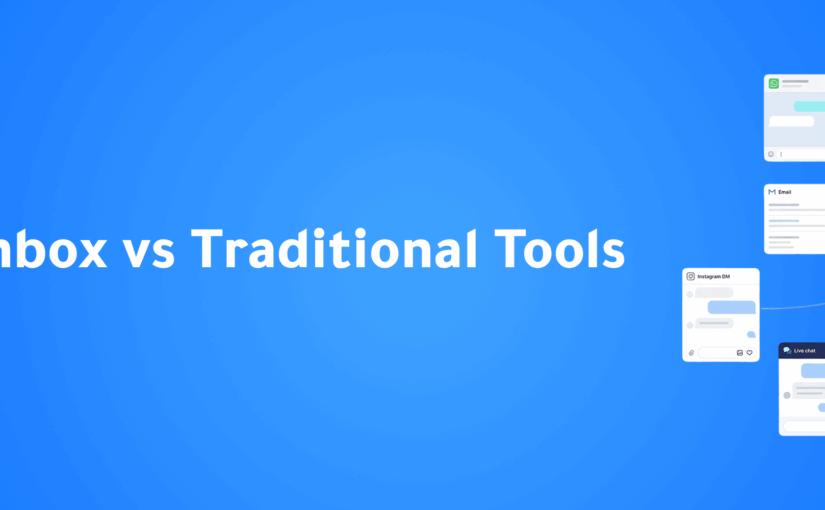
A Unified Inbox centralizes customer conversations from multiple communication channels into one workspace.
Instead of switching between several applications, customer-facing teams can manage every interaction from a single interface.
A Unified Inbox can combine conversations from:
- Facebook Messenger
- Website Live Chat
- SMS
- Mobile Applications
Every customer interaction becomes part of one connected conversation.
Why Traditional Customer Service Tools Are Becoming Outdated
Customer expectations have changed.
Businesses now need to respond faster, personalize communication, and maintain context across multiple channels.
Traditional systems struggle because they were not designed for omnichannel customer engagement.
Common limitations include:
- Disconnected conversations
- Slow response times
- Manual customer tracking
- Duplicate customer records
- Limited collaboration
- Minimal automation
As communication channels multiply, these problems become more significant.
Unified Inbox vs Traditional Customer Service Tools
| Feature | Traditional Customer Service Tools | Unified Inbox |
|---|---|---|
| Communication Channels | Limited | Multiple channels in one place |
| Customer History | Often fragmented | Complete customer timeline |
| Team Collaboration | Limited | Shared conversations and ownership |
| CRM Integration | Basic or separate | Deep CRM integration |
| AI Support | Limited | AI-powered assistance |
| Workflow Automation | Minimal | Advanced automation |
| Customer Experience | Inconsistent | Seamless across channels |
| Scalability | Limited | Designed for growing businesses |
The comparison highlights a clear trend.
Modern customer engagement requires more than traditional support software can offer.
Benefit #1: One Customer, One Conversation
Customers rarely stay on one communication channel.
A customer may:
- Discover your business on Instagram
- Ask questions on WhatsApp
- Continue through email
- Call customer support
- Return through website chat
Traditional tools treat these as separate conversations.
A Unified Inbox connects them into one complete customer journey.
Employees immediately understand the full context of every interaction.
Benefit #2: Faster Response Times
Switching between multiple applications wastes valuable time.
Support teams often lose productivity searching for conversations.
With a Unified Inbox:
- All conversations appear in one dashboard.
- Teams can prioritize urgent inquiries.
- AI can route conversations automatically.
- Responses become significantly faster.
Faster response times improve customer satisfaction and increase sales opportunities.
Benefit #3: Better Team Collaboration
Customer communication is no longer handled by one department alone.
Sales, customer support, marketing, and account management all contribute to the customer experience.
A Unified Inbox allows teams to:
- Share conversations
- Assign ownership
- Leave internal notes
- Track customer progress
- Avoid duplicate responses
Collaboration becomes much more efficient.
Benefit #4: Complete Customer Visibility
A Unified Inbox connects communication with customer data.
Instead of viewing isolated messages, employees can access:
- Contact information
- Conversation history
- Purchase records
- Open opportunities
- Support requests
- Previous interactions
This enables more personalized communication.
Customers never need to repeat the same information.
Benefit #5: AI Makes Customer Service Smarter
Modern Unified Inbox platforms integrate Artificial Intelligence directly into customer communication.
AI can:
- Respond instantly
- Qualify leads
- Detect customer intent
- Analyze sentiment
- Recommend replies
- Prioritize conversations
- Generate summaries
Instead of replacing employees, AI improves productivity while enhancing customer experiences.
Benefit #6: Workflow Automation
Traditional customer service often relies on manual processes.
Employees create tasks manually.
Managers assign conversations manually.
Follow-ups depend on reminders.
Unified Inbox platforms automate these activities.
Examples include:
- Automatic lead assignment
- CRM updates
- Task creation
- Customer journey automation
- Follow-up reminders
Automation reduces administrative work while improving consistency.
Benefit #7: Better Analytics and Reporting
Traditional support systems often provide limited reporting.
A Unified Inbox offers deeper insights, including:
- First response time
- Resolution time
- Customer satisfaction
- Conversation volume
- Agent performance
- Channel performance
- Customer engagement trends
These insights help businesses improve both customer service and operational efficiency.
Which Businesses Benefit Most from a Unified Inbox?
A Unified Inbox is particularly valuable for organizations that:
- Receive inquiries across multiple communication channels
- Have growing sales or support teams
- Manage high conversation volumes
- Want faster response times
- Need better collaboration
- Plan to implement AI-powered customer engagement
As businesses scale, managing conversations from one platform becomes increasingly important.
How ConnectGain Helps Businesses Modernize Customer Communication
ConnectGain replaces disconnected customer service tools with one intelligent customer engagement platform.
With ConnectGain, businesses can:
- Manage WhatsApp, Instagram, Messenger, website chat, email, and other channels from a Unified Inbox
- Centralize customer information through an integrated CRM
- Automate customer journeys and repetitive workflows
- Deploy AI-powered customer assistants
- Qualify leads automatically
- Analyze customer conversations using AI
- Monitor performance through real-time dashboards
By combining AI, CRM, workflow automation, and omnichannel communication, ConnectGain helps businesses deliver faster, more personalized, and more scalable customer experiences.
The Future of Customer Communication
The future of customer service is no longer about managing individual communication channels.
It is about creating one connected customer experience.
Businesses are moving toward intelligent platforms where:
- Every conversation is connected.
- AI supports every interaction.
- Automation handles repetitive work.
- Customer information is centralized.
- Teams collaborate seamlessly.
The Unified Inbox is becoming the foundation of modern customer engagement.
Conclusion
Traditional customer service tools were built for a different era—one with fewer communication channels and lower customer expectations.
Today’s businesses require faster responses, personalized communication, centralized customer data, and intelligent automation.
A Unified Inbox delivers all of these capabilities while improving collaboration, increasing productivity, and creating better customer experiences.
As customer communication continues to evolve, businesses that adopt Unified Inbox platforms will be better positioned to compete, scale, and build stronger customer relationships.
ConnectGain helps organizations modernize customer engagement by bringing conversations, CRM, AI, and workflow automation together in one intelligent platform.
Ready to Replace Disconnected Customer Service Tools?
ConnectGain helps businesses centralize customer conversations, automate workflows, and engage customers across WhatsApp, Instagram, Messenger, websites, Email, SMS, Web Push, and App Push from one AI-powered platform.
📞 WhatsApp: +20 111 998 5526
🌐 Website: https://appgain.io
📧 Email: He***@*****in.io