Introduction
A customer conversation is going well.
They are interested.
They have questions.
They are ready for the next step.
And then someone says:
“I’ll send you the proposal tomorrow.”
It sounds simple.
A friendly promise at the end of a good call.
But before anything happens, one important question needs an answer:
Where does that promise go?
In many businesses, the answer is surprisingly unreliable.
Someone remembers it.
Someone writes it in a notebook.
Someone sends themselves a message.
Someone adds it to the CRM later.
Or it simply stays in the conversation and waits to be forgotten.
The problem becomes more serious as the business grows.
More customers.
More calls.
More meetings.
More WhatsApp conversations.
More team members.
More commitments.
Suddenly, keeping track of every promise becomes an operational challenge of its own.
This is where AI Follow-Up Automation can make a significant difference.
Instead of relying on memory and manual note-taking, AI can help identify commitments inside conversations and turn them into tasks that can be reviewed, assigned, and tracked.
Because making a promise is only the beginning.
The next question is whether it becomes work—and when.
What Is Conversation-to-Task Automation?
Conversation-to-Task Automation is the use of artificial intelligence and workflow automation to identify actions inside customer conversations and convert them into structured tasks.
Traditional follow-up usually depends on people.
For example:
Call ends → Salesperson remembers → Salesperson writes a note → Salesperson creates a task
or:
Meeting ends → Someone writes minutes → Someone shares actions → Someone creates tasks
These steps work when volume is low.
But real conversations contain more than a single action.
AI can analyze additional context from the conversation itself.
For example:
What was promised?
Who made the commitment?
Which customer is involved?
When should it happen?
Is this a task, a decision, or just a discussion?
What needs to happen next?
This allows follow-up to start from the conversation, not from someone’s memory.
Why Follow-Up Matters
Businesses spend significant effort creating conversations.
Marketing.
Outbound sales.
Demos.
Customer meetings.
Support.
Account management.
But once the conversation ends, another process begins.
If the follow-up is missed, several things can happen.
The customer waits.
The salesperson forgets.
The manager does not know.
The opportunity cools down.
The customer starts to wonder whether anyone is paying attention.
Every missed follow-up creates a gap between what the customer expected and what the company delivered.
And while the company is trying to remember what was promised, the customer may already be talking to a competitor.
The Promise Gap
A promise made in a conversation has to travel a long way before it becomes work.
Conversation
↓
Someone remembers
↓
Someone writes it down
↓
Someone creates a task
↓
Someone follows up
Each step is manual.
Each step can fail.
The customer never sees the failure.
They only see that nobody came back.
We can call this the Promise Gap: the space between what was said in a conversation and what was recorded as work.
The Manual Follow-Up Problem
Imagine a company handling conversations through:
Phone calls.
Meetings.
WhatsApp.
Email.
Web chat.
Social media.
A salesperson ends a call and has already promised:
To send a proposal.
To confirm pricing.
To check an integration.
To schedule another call.
Another customer message arrives.
Then another meeting begins.
The notes from the first call are still unwritten.
When volume is low, employees can manage this manually.
As volume increases, the process becomes difficult to maintain consistently.
Why Memory Is a Poor Task Manager
Busy people don’t forget because they don’t care.
They forget because the next conversation starts before the last one is written down.
That is why follow-up is a system problem, not a discipline problem.
Asking employees to “try harder” does not solve it.
Giving them a reliable way to capture commitments does.
How Conversation-to-Task Automation Works
The exact workflow depends on the organization, but intelligent follow-up generally follows several stages.
1. Capture the Conversation
The conversation may come from any connected touchpoint.
For example:
A recorded meeting.
An uploaded recording.
A customer call.
A WhatsApp chat.
A written instruction.
The first objective is to capture what was said and connect it with the right customer.
2. Turn Speech Into Text
Calls and meetings contain commitments that were never typed anywhere.
Transcription makes them searchable and extractable.
Instead of relying on someone’s memory of a conversation, the conversation itself becomes a source of information.
3. Identify the Commitments
A transcript is not a task list.
AI can help find the parts that matter.
For example:
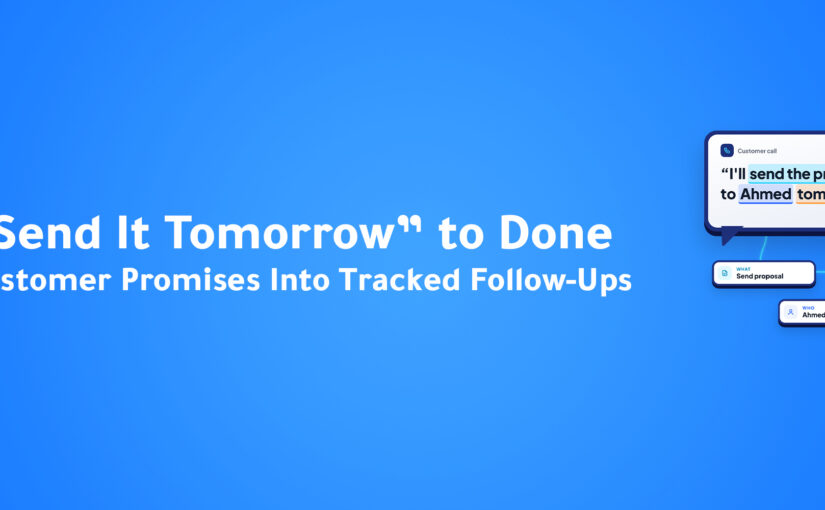
“I’ll send the proposal to Ahmed tomorrow.”
That sentence already contains useful information.
AI can identify:
Action: Send proposal
Person: Ahmed
Timing: Tomorrow
Type: Follow-up commitment
Instead of reading the full conversation again, the team can see the action directly.
4. Separate Actions From Discussion
Not everything said in a meeting is a task.
Some statements are:
Decisions.
Requirements.
Questions.
Risks.
Opinions.
Actual actions.
Extracting actions is different from summarizing.
A summary says what was discussed.
An action list says what must happen.
5. Review Before Creating Work
AI can mishear.
It can also treat a suggestion as a promise.
A quick human check keeps tasks accurate and owners accountable.
The reviewer can:
Confirm an action.
Change the owner.
Correct the date.
Reject something that was never committed.
6. Create the Task
Once the action is confirmed, the system can create the follow-up work.
For example:
Create the task.
Link it to the customer.
Assign the owner.
Set the due date.
Attach conversation context.
The salesperson receives a clear task instead of a vague memory.
7. Track Completion
Creating the task is not the end.
Teams still need to know whether it was completed.
A tracked task gives managers visibility.
The customer’s promise is no longer invisible.
Creating Tasks From a Single Sentence
Not every follow-up begins with a recorded meeting.
Sometimes a salesperson simply wants to say:
Create a follow-up task with Ahmed tomorrow.
An AI CRM assistant can understand the request.
It can identify:
Type of request: Action
Task: Follow-up
Contact: Ahmed
Date: Tomorrow
Then the connected system creates the task.
No tab-switching.
No long form.
No separate step.
Giving the AI What It Needs
Whether a task starts from a sentence or a conversation, clearer commitments are easier to capture.
A good commitment includes three things:
Who
What
When
Compare these two statements:
“We’ll look into it.”
and:
“I’ll confirm the pricing with Ahmed tomorrow.”
The first is a good intention.
The second can become a task.
Teams that state commitments clearly make it easier for both people and AI to follow through.
Follow-Up After Calls
Phone calls are one of the richest sources of customer commitments.
They also disappear quickly.
Unless someone writes notes, the information remains inside the call.
When calls are transcribed and analyzed, teams can identify:
What the customer asked for.
What the salesperson promised.
What the next step is.
Whether another call is needed.
The promise made on Monday can become a visible task on Monday afternoon.
Follow-Up After Meetings
Meetings often create several actions at once.
A salesperson needs to send a proposal.
A technical team member needs to verify an integration.
An account manager needs to confirm pricing.
The customer requested another meeting.
A manager needs to approve a special requirement.
A perfect transcript does not guarantee any of those things will happen.
Neither does a perfect summary.
Information is not execution.
Turning meeting actions into reviewed, assigned, and tracked tasks closes the gap.
Follow-Up After Chat Conversations
Chat creates a different challenge.
Messages move quickly.
Commitments are scattered.
A promise can be buried in the middle of a long thread.
“Sure, I’ll send the details.”
“Let me check and get back to you.”
“We can schedule a call next week.”
Each message may represent a follow-up.
AI can help identify these moments so they do not remain hidden in the conversation history.
Why Task Context Matters
A task without context creates a second problem.
Imagine receiving this:
Follow up with Ahmed.
Follow up about what?
Where was it discussed?
What was promised?
What does the customer expect?
A better task includes:
Customer.
Conversation summary.
Requested action.
Due date.
Related deal.
Previous interactions.
Now the salesperson can begin with:
“I’m following up on the proposal we discussed yesterday.”
The customer feels remembered.
Conversation-to-Task and Customer Experience
Follow-up sounds like an internal sales process.
But customers experience its effects directly.
Good follow-up means:
Fewer forgotten promises.
Faster responses.
Clearer next steps.
More confidence.
Less repetition.
Poor follow-up creates the opposite experience.
The customer doesn’t care how your internal tools work.
They care that you did what you said you would do.
The Cost of Lost Follow-Ups
Every missed commitment has a cost.
A proposal arrives late.
A question stays unanswered.
A meeting is not scheduled.
A decision is delayed.
A customer repeats information.
Individually, these problems seem small.
Together, they affect trust.
The objective of conversation-to-task automation is to reduce the number of promises that depend on memory alone.
ConnectGain: From Customer Conversation to Tracked Task
With ConnectGain by Appgain, conversations, CRM records, and tasks can work together in one workspace.
Ask ConnectGain, the AI assistant built into ConnectGain, can understand natural-language requests such as creating a follow-up task.
And the meeting workflow can turn reviewed and approved action items into tasks that can be tracked.
For example:
Conversation or Meeting
↓
Content Captured
↓
AI Analysis Created
↓
Action Items Identified
↓
Human Review
↓
Approval
↓
Task Created
↓
Follow-Up Tracked
The customer journey continues without requiring someone to remember, rewrite, and manually coordinate every promise.
Combining AI With Business Rules
Conversation-to-Task Automation should not mean letting AI create unlimited work without control.
The strongest systems combine AI understanding with clear business rules.
AI may identify:
Possible actions.
Customer names.
Dates.
Conversation context.
Business rules can then determine:
Which actions need review.
Who is allowed to approve.
Which tasks can be created directly.
Which tasks need extra attention.
This creates a balance between automation and accountability.
When Human Review Still Matters
Some actions should not be created automatically.
For example:
Pricing commitments.
Contract-related requests.
Complex technical promises.
Anything involving several teams.
Actions that are ambiguous or unclear.
AI can help identify these cases and prepare them for review rather than turning every phrase into a task.
Automation works best when businesses define where humans should remain involved.
How to Start With Conversation-to-Task Automation
Start by examining how follow-ups are handled today.
Ask:
Where do customer commitments appear?
Who writes them down?
How long does task creation take?
How often are follow-ups missed?
Which conversations create the most actions?
Which actions are repeated?
Who needs visibility?
Then identify the simplest improvement that would remove the most manual work.
You do not need to automate every conversation on day one.
Start with the commitments your team already creates repeatedly.
Then capture them carefully.
Metrics Worth Watching
Once follow-up automation is implemented, businesses can look at signals such as:
Time from conversation to task creation.
Follow-up completion.
Overdue follow-ups.
Tasks created from conversations.
Items edited during review.
Time to first follow-up.
Meetings or proposals completed after follow-up.
The objective isn’t simply to create more tasks.
It is to make sure the right promises become work.
The Future of Follow-Up
Follow-up is evolving from:
“Did someone remember?”
to:
“Was the commitment captured?”
AI can understand conversations.
People review and approve important actions.
Business rules define control.
Automation creates the task.
The result is a closer connection between what customers hear and what the company does.
Because the best follow-up isn’t the one that depends on the best memory.
And the best memory isn’t useful if the promise was never recorded.
Conclusion
Customers remember what you promised, even when your team doesn’t.
Manual notes, scattered chats, forgotten calls, and delayed task creation can introduce friction into one of the most important parts of the customer journey.
Conversation-to-Task Automation gives businesses a smarter way to turn spoken and written commitments into trackable work.
By capturing conversations, identifying actions, reviewing what matters, and creating tasks with context, organizations can reduce missed follow-ups and create a more reliable customer experience.
Because a promise isn’t truly kept when it’s made.
It’s kept when it becomes a task that gets done.
Ready to Stop Losing Follow-Ups?
ConnectGain by Appgain helps businesses connect customer conversations with AI assistance, CRM data, meeting workflows, and task creation.
Capture commitments, turn them into reviewed action items, create follow-up tasks, and keep customer promises visible.
The right promise. The right task. The right follow-up.
Contact Us
📞 WhatsApp: +20 111 998 5526
🌐 Website: appgain.io
📧 Email :He***@*****in.io
About Appgain
Appgain is an Agentic AI company helping businesses turn customer conversations into intelligent, connected workflows.
Through ConnectGain, organizations can connect AI with customer communication channels, CRM systems, lead qualification, routing, voice, and business workflows—helping teams move from first contact to the right next action.
ConnectGain by Appgain
AI That Works Where Your Business Works.