Building a RAG Pipeline for Product Catalogs: From CSV to Conversational AI Agent

In today’s AI-driven marketing landscape, connecting your product data to intelligent conversational agents can transform customer interactions. This comprehensive guide walks you through building a Retrieval Augmented Generation (RAG) pipeline that turns static product catalogs into dynamic AI marketing tools that can speak one-on-one to thousands of customers with personalized recommendations.

What is a RAG Pipeline and Why It Matters for Marketing

A Retrieval Augmented Generation (RAG) pipeline combines the power of large language models with your specific product data. Instead of relying solely on an AI’s general knowledge, RAG enables your conversational agents to access, retrieve, and leverage your actual product information when interacting with customers.

For marketers, this means:

  • AI agents that can accurately discuss your specific products
  • Reduced hallucinations and factual errors in AI responses
  • Dynamic product recommendations based on real-time inventory
  • Scalable personalization across thousands of customer conversations

The Components of a Product Catalog RAG Pipeline

Before diving into implementation, let’s understand the key components:

  1. Data Source: Your product catalog (CSV, database, API)
  2. Vector Database: Stores semantic representations of your products
  3. Embedding Model: Converts product text into vector representations
  4. Retrieval System: Finds relevant products based on customer queries
  5. Large Language Model (LLM): Generates natural responses incorporating product data
  6. Orchestration Layer: Connects all components into a seamless workflow

Step 1: Preparing Your Product Catalog Data

The foundation of any effective RAG pipeline is clean, structured data. Start by organizing your product catalog in a consistent format:

CSV Structure Best Practices

product_id,name,description,price,category,attributes,image_url
1001,"Wireless Earbuds","Premium noise-cancelling wireless earbuds with 24-hour battery life.",129.99,"Electronics","{color: 'black', waterproof: true}","https://example.com/images/earbuds.jpg"

Data Cleaning Considerations

  • Remove duplicate products
  • Standardize text formatting (capitalization, punctuation)
  • Ensure descriptions are detailed enough for meaningful embeddings
  • Handle missing values appropriately

For larger catalogs, consider breaking down the data processing into batches to avoid memory issues during the embedding process.

Step 2: Creating Vector Embeddings from Product Data

To make your product data searchable by AI, you need to convert text descriptions into vector embeddings – numerical representations that capture semantic meaning.

Code Example: Generating Embeddings with OpenAI

import pandas as pd
import openai
import numpy as np

# Load your product data
products_df = pd.read_csv('product_catalog.csv')

# Initialize OpenAI client
openai.api_key = "your-api-key"

# Function to create embeddings
def get_embedding(text):
    response = openai.Embedding.create(
        input=text,
        model="text-embedding-ada-002"
    )
    return response['data'][0]['embedding']

# Combine relevant fields for embedding
products_df['embedding_text'] = products_df['name'] + ": " + products_df['description'] + " Category: " + products_df['category']

# Generate embeddings (consider batching for large catalogs)
products_df['embedding'] = products_df['embedding_text'].apply(get_embedding)

# Save embeddings
products_df.to_pickle('products_with_embeddings.pkl')

Step 3: Setting Up a Vector Database

Vector databases are specialized for storing and querying embedding vectors efficiently. For a product catalog RAG pipeline, popular options include Pinecone, Weaviate, Qdrant, or even FAISS for smaller datasets.

Example: Storing Embeddings in Pinecone

import pinecone
import uuid

# Initialize Pinecone
pinecone.init(api_key="your-pinecone-api-key", environment="your-environment")

# Create index if it doesn't exist
index_name = "product-catalog"
if index_name not in pinecone.list_indexes():
    pinecone.create_index(index_name, dimension=1536)  # dimension for OpenAI ada-002 embeddings

# Connect to the index
index = pinecone.Index(index_name)

# Prepare data for upsert
vectors_to_upsert = []
for idx, row in products_df.iterrows():
    # Create a unique ID for each product
    vector_id = str(uuid.uuid4())
    
    # Prepare metadata (will be returned during search)
    metadata = {
        'product_id': str(row['product_id']),
        'name': row['name'],
        'description': row['description'],
        'price': str(row['price']),
        'category': row['category'],
        'image_url': row['image_url']
    }
    
    # Add to upsert list
    vectors_to_upsert.append({
        'id': vector_id,
        'values': row['embedding'],
        'metadata': metadata
    })

# Upsert in batches
batch_size = 100
for i in range(0, len(vectors_to_upsert), batch_size):
    batch = vectors_to_upsert[i:i+batch_size]
    index.upsert(vectors=batch)

print(f"Uploaded {len(vectors_to_upsert)} products to Pinecone")

Step 4: Building the Retrieval System

Now that your product data is embedded and stored, you need a system to retrieve the most relevant products based on customer queries. This is where domain-specific AI agents become powerful marketing tools.

Semantic Search Implementation

def search_products(query, top_k=5):
    # Generate embedding for the query
    query_embedding = get_embedding(query)
    
    # Search the vector database
    search_results = index.query(
        vector=query_embedding,
        top_k=top_k,
        include_metadata=True
    )
    
    # Format results
    products = []
    for match in search_results['matches']:
        products.append({
            'product_id': match['metadata']['product_id'],
            'name': match['metadata']['name'],
            'description': match['metadata']['description'],
            'price': match['metadata']['price'],
            'category': match['metadata']['category'],
            'image_url': match['metadata']['image_url'],
            'score': match['score']  # similarity score
        })
    
    return products

Step 5: Integrating with a Large Language Model

The final piece is connecting your retrieval system to a large language model that can generate natural, conversational responses incorporating the retrieved product information. This approach is similar to training AI personas that feel human but with specific product knowledge.

Implementing the RAG Conversation Flow

def generate_response(user_query):
    # Step 1: Retrieve relevant products
    relevant_products = search_products(user_query)
    
    # Step 2: Format product information for the LLM
    product_context = "Available products that might match this query:\n\n"
    for i, product in enumerate(relevant_products):
        product_context += f"{i+1}. {product['name']} (${product['price']}): {product['description']}\n"
    
    # Step 3: Create prompt for the LLM
    prompt = f"""
    You are a helpful shopping assistant. Use ONLY the product information provided below to answer the customer's question.
    If the information needed is not in the provided context, politely say you don't have that information.
    
    PRODUCT INFORMATION:
    {product_context}
    
    CUSTOMER QUERY:
    {user_query}
    
    Your response:
    """
    
    # Step 4: Generate response using OpenAI
    response = openai.ChatCompletion.create(
        model="gpt-4",
        messages=[
            {"role": "system", "content": "You are a knowledgeable product assistant."},
            {"role": "user", "content": prompt}
        ],
        temperature=0.7
    )
    
    return response.choices[0].message['content']

Step 6: Orchestrating the Complete Pipeline

To create a production-ready RAG pipeline, you need to orchestrate all components into a cohesive system. This can be done using frameworks like LangChain or LlamaIndex, or by building a custom solution with FastAPI or Flask.

Example: Simple FastAPI Implementation

from fastapi import FastAPI
import uvicorn
from pydantic import BaseModel

app = FastAPI()

class Query(BaseModel):
    text: str

@app.post("/query-products/")
async def query_products(query: Query):
    response = generate_response(query.text)
    return {"response": response}

if __name__ == "__main__":
    uvicorn.run(app, host="0.0.0.0", port=8000)

Step 7: Connecting to Marketing Channels

The true power of a product catalog RAG pipeline comes when it’s integrated with your marketing channels. This allows for end-to-end automation turning CRM data into real-time customer conversations.

Integration Possibilities:

  • Website Chatbots: Embed your AI agent directly on product pages
  • WhatsApp Business: Connect your RAG pipeline to WhatsApp for conversational product recommendations
  • Email Campaigns: Generate personalized product suggestions for email newsletters
  • Customer Support: Provide agents with AI-powered product information lookup
  • Social Media: Power automated responses to product inquiries on social platforms

Optimizing Your RAG Pipeline for Marketing Performance

Once your basic pipeline is operational, consider these optimizations to enhance marketing effectiveness:

1. Contextual Awareness

Incorporate user context like past purchases, browsing history, or demographic information to improve relevance.

2. A/B Testing Framework

Implement different retrieval strategies or response templates and measure which drives better conversion rates.

3. Feedback Loop

Capture user reactions to recommendations and use this data to refine your retrieval system over time.

4. Multi-modal Support

Extend your pipeline to handle image queries or return visual product information alongside text.

5. Real-time Inventory Updates

Connect your RAG pipeline to inventory systems to avoid recommending out-of-stock items.

Key Takeaways

  • RAG pipelines connect your product data to AI agents, enabling accurate and personalized customer interactions
  • The process involves data preparation, embedding generation, vector database setup, and LLM integration
  • Clean, structured product data is essential for creating meaningful embeddings
  • Vector databases provide efficient storage and retrieval of product information
  • Proper orchestration connects all components into a seamless conversational experience
  • Integration with marketing channels unlocks the full potential of AI-powered product recommendations

Conclusion

Building a RAG pipeline for your product catalog transforms static data into a dynamic asset that powers intelligent, conversational marketing. By following this end-to-end guide, you can create AI agents that accurately discuss your products, make relevant recommendations, and engage customers in meaningful conversations across multiple channels.

As AI marketing continues to evolve, businesses that effectively connect their product data to conversational agents will gain a significant competitive advantage through enhanced personalization, scalability, and customer experience.


Human-in-the-Loop AI Agents: When to Escalate and When to Automate in Marketing

Discover the optimal balance between AI automation and human intervention in your marketing workflows. As AI capabilities expand, knowing when to let your AI agents handle tasks independently and when human expertise is necessary has become a critical skill for marketing teams looking to maximize efficiency while maintaining quality.

The rise of domain-specific AI agents is transforming marketing operations, but even the most sophisticated systems require thoughtful integration with human workflows. This guide will help you design effective handoff strategies between your AI systems and human teams to create a seamless collaborative environment.

Understanding Human-in-the-Loop AI in Marketing

Human-in-the-loop (HITL) AI refers to systems where human judgment remains part of the operational cycle, providing oversight, correction, and decision-making at critical junctures. In marketing, this approach combines the efficiency and scalability of AI with human creativity, empathy, and strategic thinking.

The HITL model operates on a spectrum ranging from fully automated to completely manual processes:

  • Fully Automated: AI handles the entire process with no human intervention
  • AI with Human Review: AI performs tasks but humans verify outputs before deployment
  • Human-Guided AI: Humans make key decisions while AI handles execution
  • AI-Assisted Human Work: Humans lead the process with AI providing support and suggestions
  • Fully Manual: Humans handle the entire process with minimal or no AI assistance

When to Automate: Tasks Ideal for AI Agents

Certain marketing tasks are particularly well-suited for AI automation with minimal human oversight:

1. Data Analysis and Reporting

AI excels at processing large datasets, identifying patterns, and generating insights. Automated systems can track campaigns and build comprehensive dashboards that update in real-time, freeing your team from manual reporting tasks.

2. Routine Content Generation

For standardized content like product descriptions, social media updates, and basic email templates, AI can produce high-quality outputs at scale. These systems can maintain brand voice while dramatically increasing production capacity.

3. Campaign Optimization

AI agents can continuously monitor campaign performance, make real-time adjustments to bidding strategies, audience targeting, and creative elements to maximize ROI without constant human supervision.

4. Personalization Execution

Once personalization strategies are established, AI can handle the implementation across channels, ensuring each customer receives tailored content, recommendations, and offers based on their behavior and preferences. This personalization at scale would be impossible to execute manually.

5. Initial Customer Interactions

Chatbots and conversational AI can handle initial customer inquiries, qualification, and basic support, providing immediate responses 24/7 while collecting information that may be needed for human follow-up.

When to Escalate: Tasks Requiring Human Expertise

Despite advances in AI technology, certain marketing functions still benefit significantly from human involvement:

1. Strategic Decision-Making

Humans should lead high-level strategy development, brand positioning, and campaign planning. While AI can provide data to inform these decisions, the nuanced judgment required exceeds current AI capabilities.

2. Creative Concept Development

Original creative concepts, breakthrough campaign ideas, and innovative approaches still require human creativity. AI can assist with execution and variation, but truly novel creative direction benefits from human imagination.

3. Sensitive Communications

Communications during crises, addressing sensitive topics, or handling complex customer issues should involve human review to ensure appropriate tone, empathy, and brand alignment.

4. Complex Negotiations

Partnership development, influencer relationships, and vendor negotiations require human relationship-building skills and nuanced communication that AI cannot fully replicate.

5. Ethical Oversight

Humans must provide ethical guidance and review for marketing activities to ensure campaigns align with company values, avoid bias, and maintain appropriate standards.

Designing Effective Handoff Strategies

Creating smooth transitions between AI and human team members requires thoughtful process design:

Clear Escalation Triggers

Define specific conditions that trigger human involvement, such as:

  • Confidence thresholds (when AI confidence falls below a certain level)
  • Specific customer segments or high-value accounts
  • Unusual patterns or anomalies in data
  • Presence of sensitive keywords or topics
  • Customer explicitly requesting human assistance

Seamless Knowledge Transfer

When escalation occurs, ensure your AI systems provide human team members with all relevant context:

  • Complete conversation or interaction history
  • Customer profile and historical data
  • Actions already taken by the AI
  • Specific reason for escalation
  • Recommended next steps (if applicable)

Feedback Loops for Continuous Improvement

Implement mechanisms for humans to provide feedback on AI performance:

  • Simple rating systems for AI-generated content
  • Annotation tools to highlight errors or improvement areas
  • Regular review sessions to identify common issues
  • Documentation of successful interventions to train future models

Transparent Process Documentation

Ensure all team members understand the collaboration workflow:

  • Clear documentation of which tasks are automated vs. human-led
  • Visual process maps showing handoff points
  • Training for both technical and non-technical team members
  • Regular updates as AI capabilities evolve

Implementing HITL in Common Marketing Workflows

Content Marketing

AI handles: Draft generation, SEO optimization, basic editing, content distribution

Humans provide: Creative direction, final approval, expert insights, strategic alignment

For example, AI might generate blog drafts and optimize them for search engines, while humans review for brand voice, add unique insights, and make final editorial decisions.

Email Marketing

AI handles: Audience segmentation, template customization, A/B testing, scheduling

Humans provide: Campaign strategy, creative direction, final approval

AI can draft personalized email content and even help with email warming strategies, while humans focus on overall campaign goals and approve final messaging.

Social Media Management

AI handles: Content suggestions, posting schedule, performance tracking, basic engagement

Humans provide: Brand voice oversight, community management, crisis response

AI might suggest and schedule regular posts, while humans handle sensitive community interactions and real-time trend response.

Customer Support

AI handles: Initial response, FAQs, data collection, basic troubleshooting

Humans provide: Complex issue resolution, empathetic support, relationship building

Chatbots can handle common questions and collect information, escalating to human agents when issues become complex or emotionally charged.

Advertising Management

AI handles: Budget allocation, bid management, performance optimization, audience targeting

Humans provide: Creative direction, campaign strategy, final approval

AI can continuously optimize ad performance while humans focus on creative development and strategic decisions.

Measuring the Success of Your HITL Strategy

Evaluate your human-in-the-loop implementation with these key metrics:

Efficiency Metrics

  • Time saved by automation
  • Volume of work processed
  • Cost per marketing action
  • Team productivity increases

Quality Metrics

  • Error rates in AI outputs
  • Customer satisfaction scores
  • Content engagement metrics
  • Campaign performance

Process Metrics

  • Escalation frequency
  • Resolution time for escalated issues
  • AI confidence scores over time
  • Human intervention requirements

Team Satisfaction

  • Marketing team feedback on AI collaboration
  • Reduction in repetitive tasks
  • Increased focus on strategic work

Key Takeaways

  • Human-in-the-loop AI combines the efficiency of automation with human creativity and judgment
  • Automate routine, data-heavy, and scalable tasks while keeping humans involved in strategic, creative, and sensitive activities
  • Design clear escalation triggers and knowledge transfer processes for seamless handoffs
  • Implement feedback loops to continuously improve your AI systems
  • Measure both efficiency gains and quality outcomes to optimize your approach
  • Gradually expand automation as AI capabilities and team comfort levels increase

Conclusion

The most effective marketing operations don’t choose between AI and human expertise—they strategically combine both. By thoughtfully designing when and how your AI agents escalate to human team members, you create a system that leverages the unique strengths of each.

This human-in-the-loop approach allows you to scale your marketing efforts while maintaining quality, creativity, and the human touch that builds genuine connections with your audience. As AI capabilities continue to evolve, regularly reassess your automation/escalation balance to ensure you’re maximizing both efficiency and effectiveness.

The future of marketing isn’t AI replacing humans—it’s AI and humans working together in increasingly sophisticated ways. Start building your collaborative workflows today to stay ahead of the curve.


Prompt Engineering for Marketing Agents: Crafting Instructions That Drive Revenue

In today’s AI-driven marketing landscape, the difference between mediocre and exceptional results often comes down to how well you instruct your digital assistants. Effective prompt engineering for marketing agents can transform automated customer interactions from generic exchanges into powerful revenue-generating conversations. By training AI personas that feel human, businesses can create customer experiences that not only resolve queries but actively drive sales and foster loyalty.

Why System Prompts Matter for Marketing Success

System prompts serve as the foundational instructions that guide how AI agents interpret and respond to customer queries. Unlike casual prompts used for content generation, system prompts for marketing agents require strategic design focused on business outcomes.

When crafted properly, these instructions can:

  • Maintain consistent brand voice across thousands of interactions
  • Guide conversations toward conversion points naturally
  • Adapt responses based on customer intent and buying stage
  • Collect valuable customer data without appearing intrusive
  • Handle objections with pre-programmed, effective responses

The Anatomy of a Revenue-Driving System Prompt

Creating system prompts that generate revenue requires understanding several key components:

1. Identity and Constraints

Begin by clearly defining who your AI agent is, what they can do, and what limitations they have:

You are MarketingBot, a customer success specialist for [Brand]. 
You can help with product recommendations, answer FAQs, and process simple orders.
You cannot access customer payment details or modify existing orders.

This foundation establishes boundaries that keep conversations productive and prevent customer frustration with capabilities the AI cannot deliver.

2. Goal-Oriented Directives

Include specific business objectives that guide the AI’s responses:

Your primary goal is to guide customers toward completing purchases.
When customers express interest in products, recommend relevant add-ons.
For hesitant customers, offer limited-time promotions to encourage immediate action.

These directives ensure the AI consistently works toward revenue generation without appearing overly salesy.

3. Contextual Understanding

Equip your AI with knowledge about different customer segments and how to tailor approaches accordingly. Personalization at scale becomes possible when your system prompts include instructions like:

Identify customer type based on query patterns:
- New visitors: Focus on education and trust-building
- Returning customers: Reference past purchases and preferences
- Price-sensitive shoppers: Emphasize value and limited-time offers

4. Conversation Flow Management

Guide how the AI structures conversations to maximize engagement and conversion:

Follow this conversation structure:
1. Greet and identify customer needs
2. Provide valuable information related to their query
3. Ask clarifying questions to understand purchase intent
4. Present solutions with clear benefits
5. Address objections proactively
6. Guide toward next steps (purchase, demo, etc.)

Real-World Examples That Drive Results

Example 1: E-commerce Product Specialist

You are a Product Advisor for our premium skincare line. When customers ask about products:
1. Identify their skin concerns first
2. Recommend 1-2 core products that address these concerns
3. Suggest a complementary product that enhances results
4. Mention our satisfaction guarantee to reduce purchase anxiety
5. Provide a clear call-to-action to complete purchase

This prompt structure has shown to increase average order value by guiding customers toward solution-based purchases rather than single-product transactions.

Example 2: Service Booking Assistant

You are a Booking Specialist for our consulting firm. Your goal is to convert inquiries into scheduled consultations.
- Ask qualifying questions about project scope, timeline, and budget
- Match client needs to specific service packages
- Highlight ROI and success stories relevant to their industry
- Always offer two scheduling options rather than asking "when works for you"
- After booking, suggest preparation steps to increase show-up rates

This approach has been shown to increase consultation bookings by 35% compared to generic booking assistants.

Optimizing Prompts Through Testing and Iteration

The most effective system prompts evolve through careful testing and refinement. When optimizing your prompts:

  1. Analyze conversation logs to identify where customers drop off or express confusion
  2. Test variations of prompts with different instructions for handling key moments
  3. Track conversion metrics tied to specific prompt changes
  4. Gather customer feedback about their experience with the AI agent

Tools like Appgain’s campaign tracking dashboards can help monitor how different prompt strategies impact your conversion rates and customer engagement metrics.

Common Pitfalls in Marketing Agent Prompts

Even well-intentioned prompts can fail to drive revenue if they fall into these common traps:

  • Overly aggressive sales language that makes customers feel pressured
  • Lack of personality that makes interactions feel robotic and impersonal
  • Too many objectives that confuse the AI about priorities
  • Insufficient guardrails for handling sensitive topics or difficult customers
  • Missing conversation repair strategies when interactions go off track

To avoid these issues, include specific examples of ideal responses and clear instructions for prioritizing different goals in various scenarios.

Integrating AI Agents Into Your Marketing Ecosystem

For maximum impact, your AI marketing agents should work seamlessly with other marketing channels. Consider how your system prompts can support:

  • Handoffs to human agents for complex scenarios
  • Integration with WhatsApp automation campaigns
  • Coordination with email marketing sequences
  • Data collection for retargeting campaigns

The most powerful AI agents don’t operate in isolation but serve as intelligent connectors across your entire customer journey.

Key Takeaways

  • Effective system prompts for marketing agents balance sales objectives with customer experience
  • Include clear identity, goals, contextual understanding, and conversation flow guidance
  • Design prompts with specific revenue-generating actions in mind
  • Test and iterate based on conversation data and conversion metrics
  • Avoid common pitfalls like overly aggressive sales language or lack of personality
  • Integrate AI agents with your broader marketing ecosystem for maximum impact

Conclusion

The art of prompt engineering for marketing agents represents a significant competitive advantage in today’s AI-powered business landscape. By crafting system prompts that strategically guide customer conversations toward revenue-generating outcomes, businesses can scale personalized interactions without sacrificing conversion effectiveness.

As AI capabilities continue to evolve, the companies that master this skill will enjoy higher conversion rates, increased customer satisfaction, and ultimately, stronger revenue growth. Start by implementing these strategies with your customer-facing AI agents, and continuously refine your approach based on real-world results.

Real-Time Inventory Updates via AI Agents: Preventing COD Cancellations Before They Happen

Learn how AI agents with RAG technology can access live inventory data during customer conversations to prevent COD cancellations and improve sales conversion.

In e-commerce, few things frustrate customers more than placing a cash-on-delivery (COD) order only to discover the item is out of stock when it’s time for delivery. These last-minute cancellations not only damage customer trust but also waste valuable resources in processing, logistics, and customer service. Modern domain-specific AI agents equipped with Retrieval Augmented Generation (RAG) capabilities are revolutionizing how businesses handle inventory information during customer interactions, dramatically reducing cancellation rates and improving the shopping experience.

The High Cost of Inventory Disconnects

When customers place COD orders for products that are actually unavailable, it creates a cascade of problems:

  • Wasted fulfillment resources on orders destined for cancellation
  • Damaged customer trust and brand reputation
  • Lost revenue opportunities when alternatives aren’t offered
  • Increased customer service burden handling complaints

Traditional e-commerce systems often operate with inventory data that updates in batches, creating dangerous windows where customers can order products that have actually sold out. This disconnect between sales channels and inventory management is where AI agents with real-time data access can make a transformative difference.

How RAG-Powered AI Agents Transform Inventory Management

Retrieval Augmented Generation (RAG) allows AI systems to supplement their responses with real-time information retrieved from external databases. For inventory management, this creates powerful capabilities:

Real-Time Inventory Verification

Instead of relying on potentially outdated cache data, AI agents can query inventory management systems in real-time during customer conversations. This ensures customers only place orders for products that are genuinely available.

Intelligent Alternative Suggestions

When items are unavailable or running low, well-trained AI personas can immediately suggest similar alternatives based on customer preferences, maintaining sales opportunities rather than losing them.

Dynamic Delivery Time Updates

By connecting to supply chain data, AI agents can provide accurate delivery estimates based on current inventory location and availability, setting realistic customer expectations from the start.

Building Your RAG-Enhanced Inventory System

Implementing a real-time inventory-aware AI agent requires several key components:

1. Unified Data Architecture

Create API endpoints that allow your AI system to query inventory databases in real-time, ensuring all sales channels work from the same source of truth. This might involve:

  • REST APIs to your inventory management system
  • WebSocket connections for real-time updates
  • Caching layers with appropriate invalidation strategies

2. Contextual Awareness Training

Your AI agents need to understand when to check inventory status during conversations. Train them to recognize purchase intent signals and proactively verify availability before proceeding to checkout steps.

3. Customer-Friendly Response Strategies

Develop thoughtful response templates for out-of-stock scenarios that maintain customer interest. For example:

“I notice the blue model you’re interested in is currently out of stock. We have the same model in red available for immediate shipping, or I can notify you when the blue returns to inventory in approximately 5 days. What would you prefer?”

4. Integration with Customer Communication Channels

Deploy your inventory-aware AI agents across all customer touchpoints, especially in WhatsApp automation workflows where COD orders are often placed and confirmed.

Real-World Implementation Example

Consider this conversation flow between a customer and an AI agent with RAG-powered inventory access:

Customer: “I’d like to order the Premium Wireless Headphones in black for cash on delivery.”

AI Agent: [Queries inventory system in real-time] “I’d be happy to help with your order. I’ve just checked our warehouse, and while we have the Premium Wireless Headphones, we only have 2 units left in silver. The black version is currently out of stock. Would you like to proceed with silver instead, or would you prefer to be notified when black becomes available?”

Customer: “When do you expect to have black back in stock?”

AI Agent: [Queries supply chain system] “Our next shipment of black Premium Wireless Headphones is scheduled to arrive in our warehouse this Friday. I could place a pre-order for you with delivery expected by next Monday. Alternatively, I can offer you a 10% discount if you choose the silver model for immediate dispatch. Which option works better for you?”

Customer: “I’ll take the silver with the discount.”

AI Agent: “Excellent choice! I’ll apply the 10% discount and process your order for the silver Premium Wireless Headphones with cash on delivery. Is there anything else you’d like to add to your order today?”

This interaction demonstrates how real-time inventory checks can transform potential cancellations into successful sales while improving customer satisfaction.

Measuring Success: Key Performance Indicators

To evaluate the effectiveness of your RAG-powered inventory system, track these metrics:

  • COD Cancellation Rate: Should decrease significantly as customers only order available items
  • Alternative Product Acceptance Rate: Percentage of customers who accept suggested alternatives when first choices are unavailable
  • Customer Satisfaction Scores: Should improve as expectations are managed from the beginning
  • Average Order Value: May increase as AI suggests relevant alternatives or complementary products
  • Fulfillment Efficiency: Resources saved by not processing doomed-to-cancel orders

Implementing proper analytics dashboards will help you quantify these improvements and refine your system over time.

Key Takeaways

  • Real-time inventory verification through RAG-powered AI agents dramatically reduces COD cancellations
  • Intelligent product alternatives maintain sales opportunities even when first choices are unavailable
  • Integration across all customer communication channels ensures consistent inventory information
  • Accurate delivery time estimates improve customer satisfaction and reduce support inquiries
  • Measuring KPIs like cancellation rates and alternative acceptance helps optimize the system

Conclusion

The integration of real-time inventory data with AI conversational agents represents a significant advancement in e-commerce operations. By preventing COD cancellations before they happen, businesses can save resources, improve customer satisfaction, and increase sales conversion rates. The technology to implement these systems is accessible today through modern AI frameworks and API-driven architectures.

As customer expectations for accuracy and transparency continue to rise, real-time inventory-aware AI will become a standard feature of successful e-commerce operations rather than a competitive advantage. Businesses that implement these systems now will be well-positioned to reduce cancellations, improve operational efficiency, and build stronger customer relationships.

The ROI of AI Agents: Measuring Success Beyond Open Rates in Marketing Automation

In the evolving landscape of marketing technology, traditional metrics like open rates and click-throughs are no longer sufficient for measuring the true impact of AI-powered solutions. As AI agents become increasingly sophisticated in handling customer interactions, marketers need new frameworks to evaluate their return on investment. This article explores the metrics that truly matter when measuring the ROI of AI agents in marketing automation – from resolution rates and conversion lift to tangible cost savings.

Why Traditional Marketing Metrics Fall Short for AI Agents

For decades, marketers have relied on open rates, click-through rates, and basic engagement metrics to measure campaign success. While these metrics remain valuable for traditional campaigns, they fail to capture the unique value proposition of AI agents:

  • Conversation Quality vs. Quantity: Unlike one-way communications, AI agents engage in multi-turn conversations that can’t be measured by a single open or click
  • Problem Resolution: AI agents actively solve customer problems rather than simply delivering messages
  • Operational Efficiency: The cost-saving potential of automation extends beyond marketing outcomes

As marketing teams integrate AI agents into their workflows, they need metrics that reflect these new capabilities and their impact on both customer experience and business outcomes.

Resolution Rate: The New Conversion Metric

When deploying AI agents in customer-facing roles, the resolution rate becomes a critical metric. This measures the percentage of customer inquiries or issues that an AI agent can successfully resolve without human intervention.

How to Calculate Resolution Rate

Resolution Rate = (Number of issues resolved by AI ÷ Total number of issues presented to AI) × 100%

A high-performing AI agent might achieve resolution rates of 80-90% for certain types of inquiries, dramatically reducing the need for human intervention while maintaining customer satisfaction. This metric directly correlates with cost savings and operational efficiency.

Resolution Quality Score

Beyond simple resolution rates, sophisticated organizations track resolution quality through:

  • Customer satisfaction ratings following AI interactions
  • Reduction in follow-up inquiries on the same issue
  • Time-to-resolution compared to human agents

These nuanced measurements help marketing teams understand not just if AI agents are handling inquiries, but how effectively they’re doing so compared to human alternatives.

Conversion Lift: Measuring Direct Revenue Impact

While resolution rates focus on operational efficiency, conversion lift metrics directly measure the revenue impact of AI agents. This is particularly relevant for marketing automation systems that leverage personalization to drive sales.

A/B Testing AI Agent Performance

To accurately measure conversion lift:

  1. Create a control group that receives traditional marketing communications
  2. Create a test group that interacts with AI agents
  3. Compare conversion rates, average order value, and customer lifetime value between groups

Organizations implementing sophisticated AI agents often see conversion rate improvements of 15-30% compared to traditional marketing approaches, particularly in scenarios requiring complex decision support or personalized recommendations.

Micro-Conversion Tracking

Beyond final purchases, tracking micro-conversions provides insight into how AI agents influence the customer journey:

  • Information qualification rate (how effectively AI agents qualify customer needs)
  • Next-step completion rate (customers taking recommended actions)
  • Return engagement rate (customers willingly re-engaging with AI agents)

These metrics help marketing teams optimize AI agent performance throughout the customer journey, not just at the final conversion point.

Cost Savings and Efficiency Metrics

Perhaps the most compelling ROI metrics for AI agents relate to cost efficiency. Tracking campaign performance should include these financial impacts:

Agent Capacity Expansion

Calculate how AI agents expand your team’s capacity:

  • Inquiry Handling Volume: Total inquiries handled by AI ÷ Average inquiries handled per human agent
  • Equivalent Full-Time Employees (FTEs): Total AI agent hours ÷ Standard work hours per employee

Many organizations find that AI agents effectively double or triple their customer service capacity without proportional cost increases.

Cost Per Resolution

Compare the economics of AI vs. human agents:

  • AI Cost Per Resolution: (AI platform cost + maintenance) ÷ Number of AI resolutions
  • Human Cost Per Resolution: (Salary + benefits + overhead) ÷ Number of human agent resolutions

The differential typically shows AI resolutions costing 10-30% of equivalent human resolutions, creating substantial operational savings.

24/7 Coverage Value

Unlike human agents, AI can provide continuous service. Calculate the value of extended coverage:

  • Percentage of conversions occurring outside business hours
  • Revenue generated during non-business hours
  • Cost avoidance of staffing overnight or weekend shifts

For global businesses or those with customers across time zones, this 24/7 capability often represents significant untapped revenue potential.

Measuring Long-Term Customer Impact

Beyond immediate operational metrics, sophisticated AI agent implementations impact long-term customer relationships in ways that should be measured:

Customer Lifetime Value Impact

Compare cohorts of customers who regularly engage with AI agents versus those who don’t:

  • Retention rates over 6, 12, and 24 months
  • Average purchase frequency
  • Total customer spending over time

Organizations often discover that customers who receive consistent, personalized support from AI agents demonstrate 15-25% higher lifetime value.

Customer Effort Score

Measure the ease of doing business through AI agents:

  • Time to resolution compared to traditional channels
  • Number of steps required to complete common tasks
  • Customer-reported effort scores for AI vs. human interactions

When implemented effectively, AI agents dramatically reduce customer effort – a metric strongly correlated with loyalty and repeat business.

Building Your AI Agent ROI Dashboard

To effectively track and communicate the value of your AI agent investments, create a comprehensive dashboard that includes:

  1. Operational Metrics: Resolution rates, handling volumes, and efficiency metrics
  2. Revenue Impact: Conversion lift, average order value changes, and incremental revenue
  3. Cost Efficiency: Cost savings, capacity expansion, and ROI calculations
  4. Customer Experience: Satisfaction scores, effort reduction, and loyalty metrics

This holistic view ensures that all stakeholders understand the multi-dimensional impact of AI agents on your marketing operations and business outcomes.

Key Takeaways

  • Traditional marketing metrics like open rates fail to capture the full value of AI agents in marketing automation
  • Resolution rate is a critical metric that measures an AI agent’s ability to independently handle customer inquiries
  • Conversion lift metrics directly quantify the revenue impact of AI-driven personalization and decision support
  • Cost efficiency metrics often reveal the most compelling ROI case for AI agents, with cost-per-resolution typically 70-90% lower than human alternatives
  • Long-term customer impact metrics show how AI agents influence retention, loyalty, and lifetime value

Conclusion

As AI agents become central to marketing automation strategies, measuring their impact requires looking beyond traditional metrics. By focusing on resolution rates, conversion lift, and cost efficiency, marketers can build a compelling ROI case for continued investment in AI technology. The organizations that master these new measurement frameworks will be best positioned to optimize their AI implementations and gain competitive advantage through truly intelligent marketing automation.

Agentic Marketing Automation: Set It Once, Let AI Handle Segmentation and Personalization

Marketing automation is evolving beyond rigid workflows into intelligent systems that make autonomous decisions. This shift to agentic marketing automation represents the next frontier where AI doesn’t just follow predefined rules but actively learns, adapts, and makes decisions to optimize customer engagement. The future of personalization at scale lies in these AI agents that continuously refine segmentation and messaging without constant human intervention.

From Static Workflows to Dynamic AI Agents

Traditional marketing automation relies on if-then logic: if a customer takes action X, send message Y. While effective, this approach requires marketers to anticipate every possible customer journey path and manually update workflows as conditions change. It’s labor-intensive and inherently limited by human foresight.

Agentic marketing automation fundamentally changes this paradigm. Instead of following fixed paths, AI agents operate with:

  • Autonomous decision-making: Agents evaluate customer data in real-time and determine the next best action
  • Continuous learning: Performance feedback constantly improves the agent’s decision models
  • Adaptive segmentation: Customer groups evolve dynamically based on emerging behavioral patterns
  • Predictive personalization: Content and timing are optimized based on predicted future behaviors

How Agentic Marketing Automation Works

At its core, agentic automation replaces static decision trees with AI systems that have specific goals (like maximizing conversion or engagement) and the authority to make decisions toward those goals. Here’s how the system functions:

1. Objective Setting

Marketers define high-level business objectives and constraints rather than detailed workflows. For example, “maximize product discovery while maintaining a positive customer experience” or “increase repeat purchases without exceeding two messages per week.”

2. Autonomous Segmentation

Instead of marketers creating fixed segments, AI agents continuously cluster customers based on behavioral patterns, engagement history, and predictive models. These segments evolve automatically as the agent detects new patterns or changing behaviors.

This approach is particularly valuable in a world where third-party cookies are disappearing, making first-party data intelligence even more crucial for effective marketing.

3. Dynamic Content Selection

AI agents don’t just select from pre-written messages; they can assemble personalized content components based on what’s most likely to resonate with each customer. This might include:

  • Selecting optimal product recommendations
  • Determining the most effective messaging tone
  • Choosing the best channel mix (email, SMS, push notifications, WhatsApp)
  • Optimizing send times for maximum engagement

The ability to create truly personalized messaging is enhanced when combined with AI personas that feel human, creating interactions that feel authentic rather than automated.

4. Continuous Optimization

Unlike traditional A/B testing that requires manual setup and evaluation, agentic systems continuously experiment with variations and automatically implement winning approaches. They might test:

  • Message timing and frequency
  • Content variations
  • Incentive structures
  • Channel preferences

Building Your Agentic Marketing Infrastructure

Implementing agentic marketing requires both technological infrastructure and strategic shifts:

1. Data Unification

Agents need comprehensive customer data to make intelligent decisions. This means integrating:

  • CRM data
  • Website and app behavior
  • Purchase history
  • Campaign engagement metrics
  • Support interactions

The more unified your data, the more intelligent your automation becomes. This data foundation becomes even more powerful when you track campaigns with advanced analytics that feed back into your AI systems.

2. AI Agent Development

Creating effective marketing agents requires:

  • Clear goal definition and constraints
  • Training on historical marketing data
  • Feedback mechanisms for continuous improvement
  • Safeguards to prevent brand-damaging actions

Many organizations are now architecting their own agent infrastructure to maintain control while leveraging the power of AI.

3. Channel Integration

Agents need the ability to communicate across channels. This includes:

  • Email automation
  • SMS and WhatsApp messaging
  • Push notifications
  • Website personalization
  • In-app messaging

Real-World Applications of Agentic Marketing

Predictive Customer Journey Orchestration

Rather than forcing customers through predefined journeys, AI agents can predict the most likely next steps and proactively guide customers toward valuable actions. For example, detecting when a customer is researching a product category and automatically providing relevant information before they even request it.

Dynamic Offer Optimization

Instead of sending the same promotion to all customers in a segment, AI agents can calculate the minimum effective discount needed for each individual based on their price sensitivity, loyalty, and purchase history.

Autonomous Campaign Management

AI agents can manage entire campaigns without human intervention, from selecting target audiences to optimizing messaging and reallocating budgets based on performance. This is particularly powerful for WhatsApp automation campaigns where real-time personalization drives engagement.

Challenges and Considerations

While agentic marketing automation offers tremendous potential, it comes with important considerations:

Transparency and Control

As AI agents make more decisions, maintaining visibility into their decision-making becomes crucial. Marketers need dashboards that explain why specific decisions were made and the ability to override or guide the AI when necessary.

Ethical Boundaries

AI agents need clear ethical guidelines to prevent manipulative tactics. This includes respecting privacy preferences, avoiding excessive messaging, and maintaining brand values in all communications.

Skills Evolution

Marketing teams need to evolve from campaign builders to AI supervisors, focusing on setting objectives, reviewing agent performance, and making strategic adjustments rather than building tactical workflows.

Key Takeaways

  • Agentic marketing automation represents a paradigm shift from static workflows to autonomous AI decision-making
  • These systems continuously learn and adapt, creating dynamic customer segmentation without manual intervention
  • Implementation requires unified data, well-designed AI agents, and integrated communication channels
  • Real-world applications include predictive journey orchestration, dynamic offer optimization, and autonomous campaign management
  • Success requires balancing AI autonomy with appropriate human oversight and ethical boundaries

Conclusion

The future of marketing automation lies in agentic systems that can independently make decisions, learn from outcomes, and continuously optimize customer experiences. By shifting from rigid workflows to intelligent agents, marketers can achieve levels of personalization and efficiency previously impossible.

This transition isn’t just a technological upgrade—it’s a fundamental reimagining of how marketing teams operate. Those who successfully implement agentic marketing automation will spend less time building campaigns and more time defining strategies, while their AI agents handle the complex work of segmentation, personalization, and optimization at scale.

As we move into this new era, the competitive advantage will belong to brands that can effectively combine human creativity and strategic thinking with AI-powered execution and optimization.

From Cart Abandonment to Conversion: AI Agents That Know When to Message via SMS vs WhatsApp

The average cart abandonment rate hovers around 70%, representing billions in lost revenue for e-commerce businesses worldwide. Smart marketers know that the key to recovering these lost sales lies not just in sending a reminder, but in choosing the right messaging channel at the perfect moment. Today’s AI-powered marketing agents are revolutionizing abandoned cart recovery by intelligently deciding when to use SMS versus WhatsApp based on sophisticated channel intelligence and timing optimization.

The Critical Decision: SMS vs. WhatsApp for Cart Recovery

Not all messaging channels are created equal. Each has distinct advantages that make them more or less effective depending on customer context:

SMS Strengths:

  • Near-universal reach (98% open rates)
  • No internet connection required
  • Immediate notification delivery
  • Simplicity and directness

WhatsApp Advantages:

  • Rich media capabilities (product images, carousels)
  • Interactive buttons for one-tap cart recovery
  • More conversational experience
  • Higher engagement metrics
  • No character limits

The challenge isn’t choosing one channel over the other permanently—it’s knowing exactly which channel will work best for each specific customer at a particular moment.

How AI Agents Make Channel Intelligence Decisions

Modern AI agents analyze multiple data points to determine the optimal messaging strategy for cart abandonment recovery:

Customer Behavioral Factors

  • Previous channel response rates: Has this customer historically engaged more with SMS or WhatsApp?
  • Time since abandonment: Recent abandonments may warrant different approaches than older ones
  • Device used: Mobile shoppers might respond differently than desktop users
  • Cart value: Higher-value carts might justify more personalized WhatsApp approaches

Contextual Factors

  • Time of day: Early morning might favor SMS brevity, while evening allows for richer WhatsApp interactions
  • Geographic location: WhatsApp dominates in some regions, while SMS is preferred in others
  • Network connectivity patterns: Areas with spotty internet favor SMS reliability

By personalizing messaging at scale, AI agents can dramatically improve recovery rates compared to one-size-fits-all approaches.

Timing Optimization: The Second Critical Variable

Channel selection is only half the equation. The timing of recovery messages can make or break your conversion success:

The Science of Optimal Timing

  • First window (30-60 minutes): The golden recovery period when purchase intent is still high
  • Second window (24 hours): A natural time for a gentle reminder
  • Final window (3-5 days): Last chance to recover with potential incentives

AI agents don’t just follow static timing rules—they continuously learn from results to refine timing models for different customer segments, product categories, and seasonal factors.

Message Content Optimization Across Channels

Once the channel and timing decisions are made, AI agents also optimize message content:

SMS-Optimized Content

  • Concise, action-oriented language
  • Clear call-to-action with short links
  • Personalized elements (name, product)
  • Urgency triggers when appropriate

WhatsApp-Optimized Content

  • Rich product imagery
  • Interactive buttons (“Complete Purchase”)
  • Personalized product recommendations
  • Conversational tone with subtle urgency

The key is ensuring your messaging doesn’t get flagged as spam, which requires careful content crafting specific to each channel’s best practices.

Building Your AI-Powered Recovery System

Implementing an intelligent channel selection system requires several components:

  1. Data collection layer: Capture abandonment events, customer profiles, and historical engagement metrics
  2. Decision engine: AI models that determine optimal channel and timing
  3. Content generation system: Templates and rules for creating channel-appropriate messages
  4. Delivery infrastructure: Reliable SMS and WhatsApp Business API connections
  5. Feedback loop: Performance tracking to continuously improve decision models

The most effective systems don’t operate in isolation—they integrate with your broader marketing automation ecosystem to ensure consistent customer experiences.

Measuring Success: Beyond Recovery Rates

While the primary goal is recovering abandoned carts, sophisticated marketers track multiple metrics:

  • Channel-specific recovery rates: How SMS and WhatsApp perform comparatively
  • Time-to-recovery: How quickly customers return after receiving messages
  • Incremental order value: Do recovered carts contain additional items?
  • Long-term customer value: Do recovered customers become repeat buyers?
  • Channel preference development: How customer channel preferences evolve over time

By tracking campaigns professionally with comprehensive dashboards, you can continuously refine your channel intelligence strategy.

Real-World Results: Case Studies

Fashion Retailer: 3.2x Recovery Improvement

A mid-sized fashion retailer implemented AI-driven channel selection, resulting in a 320% increase in cart recovery compared to their previous static approach. The system discovered that younger customers responded better to WhatsApp messages with product images in the evening, while older demographics preferred concise SMS messages during business hours.

Electronics E-commerce: 41% Revenue Recovery

An electronics retailer recovered 41% of abandoned cart value by implementing a sophisticated timing and channel selection system. The AI discovered that high-value electronics purchases were more likely to be recovered via WhatsApp, where detailed product information could be shared, while accessories and smaller purchases converted better through SMS.

Key Takeaways

  • The choice between SMS and WhatsApp should be dynamic and customer-specific, not a static business decision
  • AI agents can analyze dozens of factors to determine the optimal channel and timing for each abandoned cart
  • Message content should be tailored to the strengths of each channel
  • Continuous learning and optimization are essential for long-term success
  • Look beyond simple recovery rates to measure the full impact of your cart abandonment strategy

Conclusion

Cart abandonment doesn’t have to mean lost revenue. With intelligent AI agents making sophisticated decisions about messaging channels and timing, e-commerce businesses can dramatically improve recovery rates while enhancing customer experience. The key is moving beyond static, one-size-fits-all approaches to embrace the dynamic, personalized potential of modern messaging channels.

As messaging technology and AI capabilities continue to evolve, businesses that master channel intelligence will gain a significant competitive advantage in the battle to minimize abandonment and maximize conversions.

WhatsApp Business API + AI Agents: The Ultimate COD Verification Strategy

Learn how to implement WhatsApp Business API with AI agents for automated COD verification. Boost conversion rates and reduce failed deliveries.

Cash on Delivery (COD) remains a popular payment method in many markets, but it comes with significant challenges: high return rates, delivery verification issues, and resource-intensive confirmation processes. Combining WhatsApp Automation with AI agents creates a powerful solution that can dramatically improve order confirmation rates while reducing operational costs. This technical implementation guide will walk you through setting up an automated COD verification system that feels personalized and efficient.

Why Traditional COD Verification Methods Fall Short

Before diving into our solution, let’s understand why current methods struggle:

  • Manual phone calls are time-consuming and expensive
  • Email confirmations see low open rates (15-25%)
  • SMS messages lack rich interaction capabilities
  • Customers often ignore unfamiliar communication channels

These limitations result in failed deliveries, wasted logistics resources, and frustrated customers. The solution? Leverage WhatsApp’s 98% open rate and AI’s conversational capabilities to create a verification system that actually works.

The Technical Architecture: WhatsApp Business API + AI Agents

Component 1: WhatsApp Business API Setup

To implement this solution, you’ll need:

  1. A verified WhatsApp Business Account (WABA)
  2. API access through a Business Solution Provider (BSP)
  3. Webhook endpoints to receive customer responses
  4. Message templates approved for transactional messaging

The WhatsApp Business API allows for rich media messages, interactive buttons, and automated flows that make verification both seamless and engaging for customers.

Component 2: AI Agent Infrastructure

The AI component requires:

  1. A natural language processing (NLP) engine (e.g., GPT-4, Claude)
  2. Custom training data focused on order confirmation scenarios
  3. Integration with your order management system
  4. Conversation flow design with fallback options

The AI agent needs to be trained specifically for your domain to handle various customer responses, objections, and questions about their order.

Implementation Steps: Building Your COD Verification System

Step 1: Design Your Conversation Flow

Create a conversation map that includes:

  • Initial verification message with order details
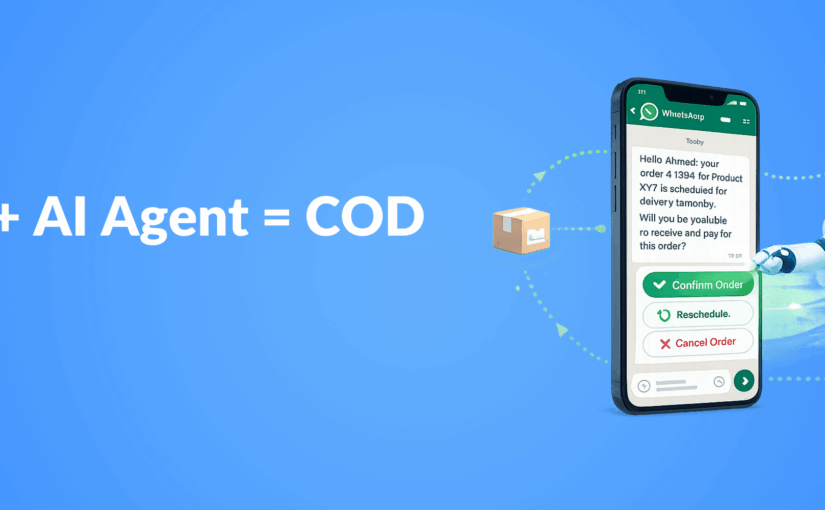
  • Confirmation request with interactive buttons (Confirm/Reschedule/Cancel)
  • Follow-up questions based on customer response
  • Handling of common objections or questions
  • Confirmation receipt and next steps

Your flow should be concise yet thorough enough to capture all necessary information.

Step 2: Develop WhatsApp Message Templates

Design and submit these templates for approval:

<Order Confirmation Template>
Hello {{1}}, your order #{{2}} for {{3}} is scheduled for delivery on {{4}}. 
Please confirm you'll be available to receive and pay for this order.
[Confirm] [Reschedule] [Cancel Order]

WhatsApp templates must be pre-approved and follow specific formatting guidelines to ensure deliverability.

Step 3: Integrate Your AI Agent

Your AI agent needs to:

  1. Parse incoming customer messages
  2. Maintain context throughout the conversation
  3. Handle natural language responses beyond button clicks
  4. Respond appropriately to customer questions
  5. Update order status in your backend systems

This is where training AI personas that feel human becomes critical – customers need to feel they’re having a natural conversation, not interacting with a robot.

Step 4: Build Backend Integration

Connect your system to:

  • Order management system (OMS)
  • Customer relationship management (CRM)
  • Logistics and delivery tracking
  • Payment processing systems

These integrations ensure that confirmation status is properly recorded and reflected throughout your operations.

Step 5: Implement Analytics and Monitoring

Set up metrics to track:

  • Confirmation rate (% of orders confirmed)
  • Response time (how quickly customers respond)
  • Conversation completion rate
  • Common objections or issues raised
  • Delivery success rate improvement

These analytics will help you continuously improve your verification process and track campaigns like a pro with proper dashboards.

Advanced Features to Consider

Multi-language Support

Configure your AI agent to detect and respond in the customer’s preferred language, expanding your system’s accessibility.

Delivery Time Optimization

Allow customers to select specific delivery time slots, reducing failed delivery attempts and improving customer satisfaction.

Rich Media Confirmations

Include product images, delivery maps, or even video instructions in your confirmation messages to increase customer confidence.

Payment Pre-authorization

Offer alternative payment methods during the verification process, potentially converting some COD orders to prepaid.

Common Implementation Challenges and Solutions

Challenge 1: Message Template Approvals

Solution: Follow WhatsApp’s guidelines strictly, avoid promotional language, and focus on transactional content.

Challenge 2: Handling Complex Customer Queries

Solution: Train your AI with a comprehensive dataset of potential questions and implement a human fallback option for complex scenarios.

Challenge 3: Integration with Legacy Systems

Solution: Develop middleware adapters or use API management tools to bridge modern WhatsApp API with older backend systems.

Challenge 4: Ensuring Compliance

Solution: Implement proper data handling, storage limitations, and clear opt-out options to maintain GDPR and other regulatory compliance.

Case Study: E-commerce Retailer Reduces Failed Deliveries by 62%

A mid-sized e-commerce company implemented this WhatsApp + AI verification system with impressive results:

  • Reduced failed delivery attempts from 24% to 9%
  • Decreased operational costs by 47% compared to manual call centers
  • Improved customer satisfaction scores by 28%
  • Achieved 94% message open rates (compared to 22% for emails)
  • Converted 12% of COD orders to prepaid during the verification process

The system paid for itself within 3 months through operational savings alone.

Key Takeaways

  • WhatsApp Business API combined with AI agents creates a powerful COD verification solution
  • Proper conversation design is critical for customer engagement and completion rates
  • Backend integration ensures verification data flows through your entire operational system
  • Analytics help continuously improve the verification process
  • Advanced features like multi-language support and rich media can further enhance effectiveness

Conclusion

Implementing a WhatsApp Business API + AI agent solution for COD verification represents a significant advancement over traditional methods. This approach not only reduces failed deliveries and operational costs but also improves customer experience through convenient, conversational interactions. By following the implementation steps outlined in this guide, e-commerce businesses can transform their order confirmation process from a liability into a competitive advantage.

Ready to revolutionize your COD verification process? The combination of WhatsApp’s unmatched reach and AI’s conversational capabilities provides a solution that benefits both your operations and your customers.

RAG vs Traditional Chatbots: Why Context-Aware AI Agents Convert 3x Better

The evolution of AI chatbots has reached a critical inflection point with Retrieval-Augmented Generation (RAG) systems delivering dramatically better results than their traditional counterparts. These context-aware AI agents are proving to be game-changers, with businesses implementing human-like AI personas reporting conversion rates up to three times higher than those using conventional rule-based chatbots. This performance gap isn’t just marginal—it represents a fundamental shift in how businesses can leverage AI for customer engagement.

Understanding the Fundamental Difference

Traditional chatbots operate on predefined rules and decision trees. They follow rigid pathways programmed by developers, recognizing specific keywords or phrases to trigger predetermined responses. While efficient for handling straightforward queries, these systems quickly reach their limits when conversations become nuanced or deviate from expected patterns.

RAG chatbots, by contrast, combine the power of large language models with the ability to retrieve and reference specific information. This architecture allows them to:

  • Access and incorporate relevant data in real-time
  • Maintain context throughout complex conversations
  • Provide accurate, data-backed responses
  • Learn and improve from interactions

The Technical Architecture That Makes RAG Superior

RAG systems employ a sophisticated two-stage process that fundamentally transforms chatbot capabilities:

1. Retrieval Component

When a user query arrives, the RAG system first searches through its knowledge base to find relevant information. This knowledge base can include:

  • Company documentation
  • Product specifications
  • Previous customer interactions
  • Up-to-date market information

The retrieval mechanism uses semantic search rather than simple keyword matching, understanding the intent behind queries to pull truly relevant information.

2. Generation Component

Once relevant information is retrieved, the large language model generates a response that incorporates this specific knowledge while maintaining conversational fluency. This approach combines the factual accuracy of retrieved information with the natural language capabilities of modern AI models.

This architecture enables sophisticated AI agent infrastructure that can handle complex customer journeys that would confound traditional systems.

Why RAG Chatbots Achieve 3x Higher Conversion Rates

The dramatic improvement in conversion rates isn’t coincidental—it’s the direct result of several key advantages:

Contextual Understanding Drives Personalization

RAG chatbots maintain conversation history and context, allowing them to provide truly personalized experiences. Rather than treating each interaction as isolated, they build a comprehensive understanding of customer needs throughout the conversation.

This contextual awareness enables them to offer solutions that precisely match customer requirements, significantly increasing the likelihood of conversion. The ability to personalize at scale creates experiences that feel tailored to each individual customer.

Reduced Friction in the Customer Journey

Traditional chatbots often force customers into rigid conversational paths, creating frustration when their queries don’t fit predefined patterns. RAG systems adapt to the customer’s communication style and needs, dramatically reducing friction points that lead to abandonment.

By maintaining context throughout interactions, these systems eliminate the need for customers to repeat information or navigate complicated menu trees, creating a smoother path to conversion.

Enhanced Problem-Solving Capabilities

When customers encounter obstacles in their journey, traditional chatbots frequently hit dead ends, unable to address unique scenarios. RAG chatbots can:

  • Understand complex, multi-part questions
  • Provide nuanced answers that address specific concerns
  • Offer creative solutions by combining different knowledge sources
  • Handle exceptions without defaulting to human escalation

This problem-solving capability keeps customers engaged in the conversion funnel rather than abandoning due to unresolved issues.

Data-Driven Recommendations

RAG chatbots leverage their access to comprehensive knowledge bases to make highly relevant product or service recommendations. Unlike traditional systems that might offer generic suggestions based on simple rules, RAG chatbots can:

  • Analyze stated and implied customer needs
  • Match these needs with specific product features
  • Provide evidence-based comparisons between options
  • Anticipate objections and proactively address them

This data-driven approach leads to recommendations that customers perceive as genuinely helpful rather than pushy sales tactics.

Real-World Implementation Challenges

Despite their clear advantages, implementing RAG chatbots comes with challenges:

Knowledge Base Management

The effectiveness of a RAG system depends heavily on the quality and organization of its knowledge base. Companies must invest in:

  • Comprehensive documentation of products, services, and policies
  • Regular updates to ensure information remains current
  • Proper structuring of information for efficient retrieval
  • Quality control processes to prevent inaccuracies

Integration Complexity

RAG systems require more sophisticated integration with existing business systems compared to traditional chatbots. Companies need to connect their RAG implementation with:

  • CRM systems to access customer history
  • Product databases for accurate information
  • Order management systems for transaction processing
  • Analytics platforms for performance tracking

Training Requirements

While RAG systems reduce the need for extensive pre-programming of responses, they still require initial training to optimize performance. This includes:

  • Fine-tuning the retrieval mechanism for relevant information selection
  • Adjusting response generation parameters for brand voice consistency
  • Creating fallback mechanisms for edge cases

Companies looking to implement domain-specific agents should consider proper AI training methodologies to maximize effectiveness.

Measuring ROI: Beyond Conversion Rates

While the 3x improvement in conversion rates is compelling, the ROI of RAG chatbots extends to multiple business metrics:

Customer Satisfaction Metrics

Companies implementing RAG chatbots typically see significant improvements in:

  • Net Promoter Scores (NPS)
  • Customer Satisfaction (CSAT) ratings
  • Reduced complaint volumes
  • Positive sentiment in feedback

Operational Efficiency

RAG systems deliver operational benefits including:

  • Lower escalation rates to human agents
  • Reduced average handling time
  • Increased first-contact resolution rates
  • Ability to handle higher interaction volumes

Long-Term Customer Value

The improved customer experience provided by RAG chatbots contributes to:

  • Higher customer retention rates
  • Increased repeat purchase frequency
  • Larger average order values
  • More positive word-of-mouth and referrals

Key Takeaways

  • RAG chatbots leverage retrieval-augmented generation to provide contextually relevant, accurate responses that traditional chatbots cannot match.
  • The 3x improvement in conversion rates stems from enhanced personalization, reduced friction, superior problem-solving, and data-driven recommendations.
  • Implementing RAG systems requires investment in knowledge base management, integration capabilities, and proper training.
  • ROI extends beyond conversion rates to include improved customer satisfaction, operational efficiency, and long-term customer value.
  • As AI technology continues to evolve, the gap between RAG and traditional chatbots is likely to widen further.

Conclusion

The shift from traditional rule-based chatbots to context-aware RAG systems represents a quantum leap in customer engagement capabilities. With conversion rates three times higher than conventional approaches, RAG chatbots deliver compelling ROI while simultaneously improving customer experience across multiple dimensions.

As businesses compete for customer attention in increasingly crowded digital spaces, the ability to provide intelligent, contextual, and helpful automated interactions will become a critical competitive advantage. Organizations that invest in RAG technology now will establish a significant lead over those relying on increasingly outdated rule-based systems.

Multi-Agent Systems for E-commerce: Coordinating Sales, Support, and Fulfillment Bots

Discover how multi-agent systems coordinate sales, support, and fulfillment bots to create seamless e-commerce experiences and boost conversion rates.

The e-commerce landscape is evolving rapidly with AI technologies transforming how online businesses interact with customers. At the forefront of this revolution are multi-agent systems—coordinated networks of specialized AI bots working together throughout the customer journey. These systems are revolutionizing how personalized shopping experiences are delivered at scale, creating seamless interactions from initial product discovery to post-purchase support.

What Are Multi-Agent Systems in E-commerce?

Multi-agent systems in e-commerce are collaborative networks of AI agents, each designed to handle specific aspects of the customer journey. Unlike standalone chatbots, these systems feature multiple specialized bots that communicate with each other, share data, and coordinate their actions to provide a cohesive customer experience.

The core components typically include:

  • Sales Agents: Product recommendation engines and conversational shopping assistants
  • Support Agents: Customer service bots handling inquiries and issue resolution
  • Fulfillment Agents: Order processing, inventory management, and logistics coordination bots

These agents work in concert, sharing customer data and context to create a seamless experience across touchpoints.

The Orchestration of AI Agents Throughout the Customer Journey

Pre-Purchase: Sales Agents in Action

The customer journey begins with sales agents that engage potential buyers through personalized recommendations and interactive shopping assistance. These agents analyze browsing behavior, purchase history, and demographic data to suggest relevant products.

Modern sales agents can:

  • Provide real-time product comparisons
  • Offer personalized discounts based on browsing behavior
  • Answer detailed product questions instantly
  • Guide customers through complex product configurations

By training these AI personas to feel human, e-commerce businesses can create engaging shopping experiences that significantly boost conversion rates.

During Purchase: Coordinated Handoffs Between Agents

As customers move toward purchase decisions, the system orchestrates smooth transitions between different agent types. For example, when a customer asks about shipping options, the sales agent can seamlessly transfer the conversation to a fulfillment agent while maintaining context.

This coordination happens through:

  • Shared customer profiles and conversation history
  • Real-time inventory and pricing data synchronization
  • Contextual handoffs that preserve the conversation flow

The key to successful multi-agent systems is making these transitions invisible to the customer, creating the impression of interacting with a single, knowledgeable entity.

Post-Purchase: Support and Fulfillment Agents

After purchase, support and fulfillment agents take center stage. Fulfillment agents track orders, coordinate with inventory systems, and provide shipping updates. Meanwhile, support agents handle post-purchase questions, returns processing, and proactive customer satisfaction checks.

These agents can:

  • Provide real-time order tracking information
  • Process return requests automatically
  • Offer troubleshooting assistance for products
  • Collect and analyze customer feedback

The Technology Behind Multi-Agent Coordination

Effective multi-agent systems rely on sophisticated orchestration technologies that enable communication and coordination between different AI agents. This orchestration layer manages the flow of information, determines which agent should handle specific customer needs, and ensures consistent customer experiences.

Key technologies enabling this coordination include:

  • Shared Knowledge Bases: Centralized repositories of product information, customer data, and conversation history
  • Intent Recognition Systems: AI that accurately identifies customer needs to route them to the appropriate agent
  • Context Management: Systems that maintain conversation context during agent handoffs
  • Workflow Automation: Predefined processes for common customer journeys

By architecting a robust agent infrastructure, e-commerce businesses can create systems that scale efficiently while maintaining personalized customer experiences.

Real-World Benefits of Multi-Agent Systems

E-commerce businesses implementing multi-agent systems are seeing significant benefits:

Increased Conversion Rates

By providing personalized product recommendations and answering questions instantly, sales agents can significantly boost conversion rates. Research shows that AI-powered product recommendations can increase conversion rates by 30% or more.

Reduced Cart Abandonment

Support agents that proactively address concerns during checkout can dramatically reduce cart abandonment. For example, instantly answering shipping questions or offering real-time assistance with payment issues can recover sales that would otherwise be lost.

Enhanced Customer Satisfaction

The seamless experience provided by coordinated agents leads to higher customer satisfaction. Customers receive consistent, personalized service across all touchpoints, building trust and loyalty.

Operational Efficiency

Automating routine customer interactions frees human staff to focus on complex issues and high-value activities. This improves operational efficiency while reducing costs.

Implementation Challenges and Solutions

Despite their benefits, implementing multi-agent systems comes with challenges:

Data Integration Complexity

Multi-agent systems require integration with multiple data sources, including product catalogs, inventory systems, customer databases, and order management systems.

Solution: Implement a unified data layer that standardizes information from different sources, making it accessible to all agents in a consistent format.

Maintaining Conversation Coherence

Ensuring smooth transitions between agents without losing context can be difficult.

Solution: Develop robust context management systems that maintain conversation history and customer intent during handoffs.

Training Specialized Agents

Each agent type requires specialized training for its specific role in the customer journey.

Solution: Use role-specific training datasets and continuous learning processes to improve agent performance over time.

Future Trends in Multi-Agent E-commerce Systems

The evolution of multi-agent systems in e-commerce is just beginning. Several emerging trends will shape their future development:

Emotion Recognition and Response

Future agents will better recognize customer emotions and adjust their responses accordingly, providing more empathetic and effective service.

Proactive Engagement

Rather than waiting for customer inquiries, advanced systems will proactively engage customers at optimal moments in their shopping journey.

Cross-Channel Coordination

Multi-agent systems will seamlessly coordinate across channels, maintaining context whether the customer is on a website, mobile app, or messaging platform.

Autonomous Decision-Making

Advanced agents will gain more autonomy to make decisions within defined parameters, such as offering personalized discounts or expedited shipping to prevent cart abandonment.

Key Takeaways

  • Multi-agent systems coordinate specialized AI bots across the entire customer journey, creating seamless e-commerce experiences
  • Effective orchestration between sales, support, and fulfillment agents is critical for maintaining context and conversation coherence
  • These systems can significantly increase conversion rates, reduce cart abandonment, and improve customer satisfaction
  • Successful implementation requires robust data integration, context management, and specialized agent training
  • Future systems will incorporate emotion recognition, proactive engagement, and greater autonomy in decision-making

Conclusion

Multi-agent systems represent the future of e-commerce customer engagement, moving beyond single-purpose chatbots to create truly integrated, intelligent shopping experiences. By coordinating specialized agents across the customer journey, e-commerce businesses can deliver personalized service at scale while improving operational efficiency.

As these technologies continue to evolve, the businesses that successfully implement multi-agent systems will gain significant competitive advantages through enhanced customer experiences and increased operational efficiency. The future of e-commerce belongs to those who can effectively orchestrate these digital workforces to create seamless, personalized customer journeys.