How AI and Automation Transformed Furniture eCommerce in Egypt and GCC

Overview

  • Sector: Furniture eCommerce & Circular Economy
  • Location: Egypt & GCC
  • Solution: AI Furniture Ecommerce + Automation

Introduction

AI furniture ecommerce is transforming how customers shop for furniture online.

However, in competitive markets like Egypt and GCC, growth is not driven by product variety alone. Instead, it depends on how fast customers can make confident decisions.

Nabolia faced a critical issue. Customers were interested, but hesitation during the buying journey slowed conversions and increased returns.

Therefore, Appgain stepped in to solve this challenge using AI, automation, and data.


The Challenge

However, Nabolia needed to solve multiple friction points across the customer journey:

  • Standing out in a saturated market
  • Reducing long decision cycles
  • Lowering return rates
  • Encouraging sustainable purchasing

The core issue was simple. Customers could not clearly visualize products in their own spaces.

As a result, hesitation increased. Decisions were delayed. Returns also became higher.


The Appgain Approach

To solve this, Appgain rebuilt the entire experience.

The strategy focused on three key layers:

  • Platform optimization
  • AI-powered visualization
  • Marketing automation

Re-Platforming for Performance and Scalability

First, Nabolia was re-platformed on Shopify Online Store 2.0.

This improved performance and flexibility.

Key improvements included:

  • A bilingual experience (Arabic and English)
  • Mobile-first UX
  • Faster loading speeds

As a result, the platform became ready for scale.


How AI Furniture Ecommerce Reduced Purchase Uncertainty

To solve the biggest problem, Appgain introduced an AI-powered Room Designer.

This AI furniture ecommerce feature allows users to:

  • Upload a photo of their room
  • Select style and colors
  • Receive realistic furniture layouts

Instead of guessing, customers can now see real results.

As a result, confidence increased and hesitation decreased.


Marketing Automation: Turning Intent into Revenue

In addition, Appgain implemented a full automation system.

This AI furniture ecommerce approach includes:

  • Cart recovery via WhatsApp and push notifications
  • Personalized product recommendations
  • Real-time engagement triggers

This was not traditional automation.

Instead, it was an AI-driven system.
It connects user intent with real-time actions.
As a result, no opportunity is missed.


Data and Analytics for Continuous Growth

Moreover, Appgain added a powerful analytics layer.

This helps Nabolia understand user behavior clearly.

It includes:

  • Lifetime value tracking
  • Heatmaps for behavior analysis
  • Sustainability tracking

Therefore, every decision becomes data-driven.


Results

The AI furniture ecommerce transformation delivered strong results:

  • 300% growth in GMV year-over-year
  • 25% increase in Add-to-Cart rate
  • Return rate reduced from 12% to 4.5%
  • 11 tons of furniture saved from landfill

Clearly, combining AI and automation drives real growth.


Why This Strategy Worked

This success came from integration, not isolated features.

  • AI reduced uncertainty
  • Automation reduced friction
  • Data enabled optimization

As a result, the entire customer journey improved.


Technology Stack

The solution was built using:

  • Shopify Online Store 2.0
  • Python (FastAPI)
  • Stable Diffusion + DreamBooth
  • Node.js
  • Appgain SDK
  • Firebase
  • BigQuery + Looker Studio

Conclusion

Nabolia proves that success in AI furniture ecommerce depends on simplifying decisions.

When customers feel confident, they buy faster.

Therefore, businesses must focus on experience, not just products.


Build Your Own Success Story

If your business wants to grow, focus on reducing friction.

Nabolia shows that AI furniture ecommerce can transform both experience and revenue.

👉 Explore more Appgain success stories:
https://appgain.io

👉 Learn more about AI in ecommerce:
https://cloud.google.com/learn/what-is-artificial-intelligence


Start Your Growth Journey Today

Appgain helps businesses build scalable, high-performance digital solutions.

Let’s build your success story.

Peak Pharma: B2B Ordering Transformation Case Study

Overview

  • Industry: Pharmaceutical Distribution
  • Solution: B2B Ordering System + Automation + Analytics
  • Go-Live: 14 Days

From Manual Chaos to a Scalable B2B Ordering System

Peak Pharma struggled with a manual B2B ordering system that relied on calls, WhatsApp messages, and scattered communication.

Orders got lost.
Mistakes happened.
Delays became normal.

At first, the process worked. However, as the business grew, the system became inefficient.

What started as a simple workflow quickly turned into operational chaos—slowing down fulfillment, increasing errors, and limiting scalability.

Clearly, Peak Pharma needed more than a basic system. It needed a modern, scalable B2B ordering system.


The Challenge: Scaling Without a Reliable B2B Ordering System

Before going digital, Peak Pharma faced several challenges:

  • Manual order handling across multiple channels
  • Frequent data entry errors
  • No real-time visibility into order status
  • Difficulty managing over 2,000 SKUs
  • Heavy reliance on manual processes

As a result, operations became difficult to control.

Therefore, the business needed a B2B ordering system that could:

  • Enable fast and easy ordering
  • Reduce errors significantly
  • Provide real-time tracking
  • Centralize operations
  • Support rapid growth

The Solution: Building a Scalable B2B Ordering System

To solve this, Appgain developed a powerful B2B ordering system powered by automation and analytics.

The focus was clear: speed, accuracy, and scalability.


Always-On Ordering Experience

With the new B2B ordering system, pharmacies can now place orders anytime through a mobile and web platform.

They can:

  • Browse a real-time product catalog
  • Use advanced search and filters
  • Place orders instantly
  • Upload bulk orders in seconds

As a result, what used to take hours now takes minutes.


Real-Time Tracking and Visibility

In addition, the B2B ordering system provides full visibility across the order lifecycle.

Pharmacies can track orders in real time:

  • In progress
  • Picked
  • Completed

Therefore, there is no uncertainty and no need for constant follow-ups.


Automated Communication That Saves Time

To improve communication, Appgain integrated automation into the B2B ordering system.

This includes:

  • Instant WhatsApp notifications
  • OTP-based confirmations
  • Automated reminders

As a result, communication became faster, clearer, and more reliable.


Recovering Lost Orders with Automation

Previously, many orders were abandoned or missed. However, this is no longer the case.

With automation built into the B2B ordering system:

  • Abandoned orders trigger reminders
  • Customers receive targeted messages
  • Multi-channel engagement drives action

Therefore, missed opportunities are now converted into measurable revenue.


Data-Driven Decision Making

The B2B ordering system does more than process orders—it provides insights.

Peak Pharma can now:

  • Track customer behavior
  • Analyze demand patterns
  • Optimize inventory
  • Improve operations

This means every decision is backed by real data.


Key Results

The impact of the new B2B ordering system was immediate and measurable:

  • Platform launched in just 14 days
  • 90% adoption in the first week
  • Errors reduced from 7% to under 1%
  • 12% of abandoned orders recovered

This was not just an improvement—it was a complete transformation.


Why This B2B Ordering System Matters

Today, businesses can no longer rely on manual processes.

Instead, they need:

  • Real-time systems
  • Automation
  • Unified platforms

A modern B2B ordering system enables faster operations, higher accuracy, and scalable growth.


The Appgain Approach

This transformation succeeded because of:

  • Fast and efficient delivery
  • Simple user experience
  • Automation across the full journey
  • Seamless integration between systems

What’s Next

With this scalable B2B ordering system, Peak Pharma is now positioned to:

  • Expand its customer base
  • Handle higher order volumes
  • Optimize supply chain efficiency
  • Scale without operational bottlenecks

Build Your Own Success Story

If your business still depends on manual processes, growth will always be limited.

However, with the right B2B ordering system, transformation can happen faster than expected.

Peak Pharma proves that digital transformation can deliver real results in a short time.

👉 Explore more success stories: https://appgain.io

👉 Learn more about order management systems:
https://www.ibm.com/topics/order-management


Start Your Growth Journey Today

If you are looking to scale your business with a powerful B2B ordering system, Appgain is your trusted partner.

Whether you’re building a B2B platform or optimizing operations, our team is ready to help you achieve measurable results.

Let’s build your success story.

Appgain 2024 Review: A Year of Growth, Innovation, and New Horizons

As we step into 2025, we take a moment to reflect with immense gratitude and excitement on the incredible journey we had in 2024. It was a year filled with challenges, breakthroughs, and milestones that shaped the future of Appgain. From launching transformative solutions to forging new partnerships, 2024 stands as a testament to innovation, collaboration, and relentless hard work.

Let’s take a moment to celebrate what we’ve achieved together in this Appgain 2024 review.

Innovation Driving Our Growth

Innovation has always been at the heart of our mission. In this Appgain 2024 review, we highlight some of our most impactful developments.

  • AI-Powered Marketing Tools: This year, we enhanced personalization with AI-driven customer segmentation and optimized communication timing. As a result, businesses can now engage their audiences in smarter and more meaningful ways.
  • Empowering E-Commerce with Shrinkit: Our flagship platform, Shrinkit, became even more powerful. New features, such as abandoned cart recovery and audience syncing with Meta, were introduced. Additionally, we integrated with major platforms like Salla, Zid, and Shopify, making it an essential tool for businesses looking to automate and scale their marketing efforts.
  • RetailGain Reimagined: We took RetailGain to the next level by adding a mobile app builder and a website builder. Consequently, retailers can now establish their digital presence quickly and effortlessly.
  • Coc Eyewear Shopify App: In collaboration with Coc Eyewear, we developed a Shopify Lens Selector App. This innovative tool is transforming how customers shop for eyewear online.

Strategic Moves for Sustainable Growth

While innovation propels us forward, strategic decision-making ensures that we grow sustainably. In this Appgain 2024 review, we also acknowledge the key strategic moves we made.

  • Introducing Appgain Studio: We launched Appgain Studio, a dedicated division specializing in mobile app development, Odoo ERP projects, and VR solutions. This new division has already unlocked exciting opportunities and expanded our capabilities.
  • Becoming an Odoo Partner: This year, we officially became an Odoo Partner. This milestone marks our expansion into the ERP space, allowing us to help businesses streamline their operations with intelligent tools that drive efficiency and growth.
  • Exiting the Turkish Market: Sometimes, growth requires tough decisions. After thorough evaluation, we decided to exit the Turkish market to concentrate our efforts on areas with stronger growth potential.

Looking Ahead to 2025

As we step into 2025, we remain committed to innovation, collaboration, and delivering exceptional value to our clients. The lessons learned and achievements of 2024 will guide us in the coming year, ensuring that we continue to evolve and make a meaningful impact.

Thank you to our clients, partners, and team members for being part of this journey. Together, we look forward to another year of growth and success!
Ready to take your business to new heights of success? ?
At Appgain, we believe in the power of collaboration and innovation to help you achieve your goals. If you’re curious about how we can assist you in driving sustainable growth and scaling your business, reach out to us on WhatsApp today!
Let’s talk about new opportunities, innovative solutions, and how we can move your business forward.

Thopify Move to Shopify – A Success Story with Appgain’s Tools

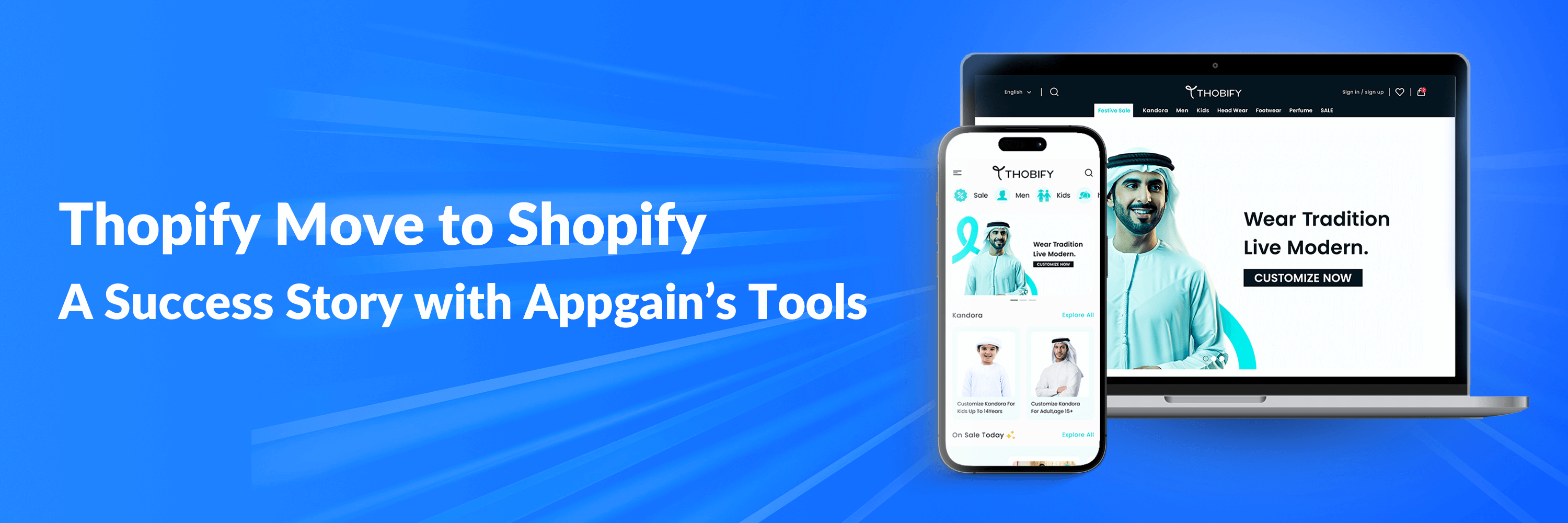
In today’s fast-changing digital world, e-commerce platforms like Thopify need to keep improving. Recently, Thopify move to Shopify (formerly Cancan Online) marked a significant shift as they switched from a PHP system to a powerful Shopify platform. This transition was crucial for Thopify to enhance user engagement and improve shopping experiences. Appgain led this change by using our AI and marketing tools. Here’s how we did it, and why Thopify move to Shopify was essential for their growth.

Why Thopify Needed to Change

Thopify is a popular online fashion store. However, they faced several challenges:

First, they struggled to grow their operations. Additionally, users were not engaged. Finally, they needed a more personalized shopping experience. To solve these problems, Thopify decided to move to Shopify. This platform offers faster performance, better security, and easy connections to helpful marketing tools. Therefore, the change was essential for Thopify move to Shopify.

How Appgain Helped Thopify

At Appgain, we aim to help businesses grow. Thus, we followed key steps to transform Thopify using our knowledge in AI marketing and custom development.

Moving from PHP to Shopify
First, we shifted Thopify backend from PHP to Shopify. This change brought many benefits:
As a result, Thopify became faster and easier to grow. Moreover, it allowed simple integration with marketing tools like Appgain’s Marketing SDK. Additionally, security was improved, making shopping safer for users.

Adding Appgain Marketing SDK
Next, we added the Appgain Marketing SDK to Thopify Shopify platform. This provided important benefits:
For instance, personalized push notifications and in-app messages kept users interested. In addition, user segmentation allowed for targeted campaigns based on behavior. Also, deep linking directed users to specific content, which improved conversion rates. Finally, automated marketing campaigns helped recover abandoned carts, leading to more sales.

Integrating MirrorSize SDK
Furthermore, we added the MirrorSize SDK to Thopify app. This feature allows users to:
Specifically, take body measurements using their smartphones. In addition, they receive size recommendations, which reduces returns. As a result, users enjoy a smoother shopping experience based on their body size.

Creating a Custom Fashion Builder App
Lastly, we developed a custom fashion builder app for Thopify. This app lets users:
Easily customize clothing designs to match their preferences. Moreover, they can select sizes, colors, and other features. Thus, they have a more engaging shopping experience overall.

The Results of Thopify’s Change

The changes at Thopify led to great results:
For example, user engagement increased. The Appgain Marketing SDK boosted click rates on notifications, leading to more user interaction. Additionally, there were fewer returns. Thanks to the MirrorSize SDK, users chose the right sizes, resulting in happier customers. Moreover, faster product launches became possible. With Shopify’s help, Thopify could introduce new products quickly. Overall, the custom fashion builder app made shopping more interactive and personal.

Conclusion: A New Chapter for Thopify

In summary, the change from Cancan Online to Thopify shows how digital transformation can help a business grow. By using Appgain’s Marketing SDK, AI technology, and custom development, Thopify move to Shopify can now provide a better shopping experience. Ultimately, this project demonstrates how Appgain’s solutions can help any e-commerce platform succeed.

Mastering Saudi Arabia’s Personal Data Protection Law: A Guide to Compliance and Rights

Understanding Saudi Arabia’s PDPL

Saudi Arabia has created its first data protection law called the Personal Data Protection Law (PDPL). This law aims to protect personal data privacy. It regulates how organizations collect, process, disclose, or keep personal data.

Regulatory Framework and Enforcement

What is the PDPL?

Saudi Arabia has created a new law called the Personal Data Protection Law (PDPL). This law protects personal data privacy. It controls how organizations collect, use, share, or keep personal data.

Who Enforces the PDPL?

The Saudi Data & Artificial Intelligence Authority (SDAIA) will enforce the PDPL for the first two years. After that, the National Data Management Office will take over. The PDPL has rules for data processing, the rights of individuals, the duties of organizations, and how to handle data transfers between countries.

When Does the PDPL Start?

The PDPL was supposed to begin on March 23, 2022. After public feedback, the start date was changed to September 14, 2023. Organizations now have until September 14, 2024, to follow the new rules.

Who Must Follow the PDPL?

The PDPL applies to all organizations in Saudi Arabia. This includes private and public groups. It also covers foreign companies that deal with data of people in Saudi Arabia. The law includes all types of personal data, even sensitive data, and applies even after someone has died.

What Must Organizations Do?

Under the PDPL, organizations must:

  • Get clear consent from individuals before using their data.
  • Ensure data is processed for valid reasons and shared transparently.
  • Implement security measures to protect personal data.
  • Appoint a data protection officer for compliance.
  • Create processes to notify people about data breaches.

To assist organizations in managing customer data effectively and ensuring compliance with the PDPL, Appgain’s CRM application offers valuable tools for enhancing customer interactions and data management.

What Rights Do Individuals Have?

The PDPL gives people control over their personal data. They have the right to:

  • Access their data held by organizations.
  • Ask for corrections or deletion of incorrect data.
  • Withdraw consent for data processing at any time.
  • Be informed about how their data is used.

How Are Data Transfers Handled?

The PDPL has strict rules for transferring data outside Saudi Arabia. Transfers are allowed only if the receiving country has good data protection. The SDAIA must confirm this. Organizations must also assess risks before transferring data internationally.

What Happens If Organizations Don’t Comply?

Penalties for not following the PDPL include:

  • Fines up to SAR 5 million ($1.3 million).
  • Possible jail time for serious mishandling of sensitive data.
  • Warnings or loss of licenses for repeated offenses.

How Can Organizations Comply?

To comply with the PDPL, organizations should:

  • Keep track of their data.
  • Create clear data processing policies.
  • Set up strong systems for notifying data breaches.
  • Train staff regularly on PDPL rules.

This guide explains the PDPL and what organizations must do. It also details the rights of individuals. Organizations in Saudi Arabia must protect personal data according to these new laws.

The Saudi Data & Artificial Intelligence Authority (SDAIA) will enforce the PDPL for the first two years. After that, the National Data Management Office will take over. The law provides a clear framework for data processing, rights of data subjects, obligations of organizations, and rules for transferring data across borders. If organizations do not comply with the PDPL, they may face penalties.

Implementation Timeline

The PDPL was supposed to start on March 23, 2022. However, after public consultation, the date changed to September 14, 2023. Organizations now have a one-year grace period until September 14, 2024, to comply with the law.

Who Must Comply?

The PDPL applies to all organizations, both private and public, that process personal data of people in Saudi Arabia. This includes foreign companies. The law covers all types of personal data, including sensitive data. It even applies to data after a person has died.

Organizational Obligations Under PDPL

Organizations must follow several rules under the PDPL, including:

  • Getting clear consent from data subjects before processing their data.
  • Ensuring data is processed for legitimate reasons and in a clear way.
  • Implementing security measures to protect personal data.
  • Appointing a data protection officer to manage compliance.
  • Setting up processes for notifying about data breaches.
    In this context, the Shrinkit application developed by Appgain emerges as an innovative and reliable solution. Leading platforms such as Salla, Shopify, and Zed have trusted it, reflecting their confidence in its capabilities. Shrinkit is an effective tool for meeting the compliance requirements of the PDPL, ensuring data security while maintaining transparency.

Data Subject Rights

The PDPL gives individuals control over their personal data. They have the right to:

  • Access their data held by organizations.
  • Request corrections or deletion of incorrect data.
  • Withdraw consent for data processing at any time.
  • Be informed about how their data is used.

Cross-Border Data Transfers

There are strict rules for transferring personal data outside Saudi Arabia. Transfers are allowed only if the receiving country has strong data protection standards. The SDAIA must confirm these standards. Organizations must also conduct risk assessments before transferring data internationally.

Compliance and Penalties

Penalties for not following the PDPL include:

  • Fines up to SAR 5 million ($1.3 million).
  • Possible imprisonment for serious mishandling of sensitive data.
  • Warnings or loss of licenses for repeated violations.

Operationalizing PDPL Compliance

To comply with the PDPL, organizations should:

  • Keep an inventory of their data.
  • Develop clear data processing policies.
  • Establish strong data breach notification systems.
  • Regularly train staff on PDPL requirements.

Effective communication with customers is key to compliance. Organizations should explore how to optimize their notification strategies to maintain engagement without overwhelming their audience. For guidance on this, refer to the article on Optimal Notification Frequency in E-commerce.

Conclusion

In conclusion, the Personal Data Protection Law (PDPL) represents a significant step forward in safeguarding privacy in Saudi Arabia. Organizations must take these regulations seriously to avoid penalties and maintain customer trust. Appgain.io emerges as a reliable partner in this endeavor, offering advanced solutions to ensure compliance with the new laws. With innovative tools, Appgain.io helps organizations enhance data protection and ensure transparency in data processing.

This guide provides an overview of the PDPL, outlining the responsibilities organizations must uphold and the rights individuals possess. It is essential for businesses in Saudi Arabia to take proactive measures to protect personal data in accordanc3e with these new regulations.